tecoacualli (FCbk11f80v)
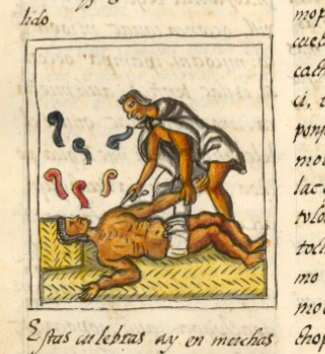
This iconographic example, featuring a man trying to cure another of a snakebite (tecoacualli), is included in this digital collection for the purpose of making comparisons with related hieroglyphs. The term selected for this example comes from the text near the image in the Digital Florentine Codex. There is no gloss, per se. This example shows one man lying down on a woven mat (petlatl) and another one that elevates his head. He wears only a loincloth. His body is in a ¾ view, but his head is in profile, looking upward. Another man, wearing a cloak (tilmatli, or tilmahtli) tied over his chest, holds a knife or scissor for cutting into the snakebite, which is apparently located on the ailing man’s left shoulder. The text explains how the bite mark is cut open so that the venom can be extracted. It was a rattlesnake of a type called the chiyahuitl that had bitten the victim. Both the victim and the healer are speaking, with volutes emerging from their mouths. The ailing man speaks in red, yellow, and dark gray speech scrolls. The healer emits one dark gray scroll.
Stephanie Wood
These speech scrolls could be relevant for a study of their variations Since the man who was bitten was supposed to be very hot, perhaps the color of his scrolls reflects heat. The red might also suggest pain.
Stephanie Wood
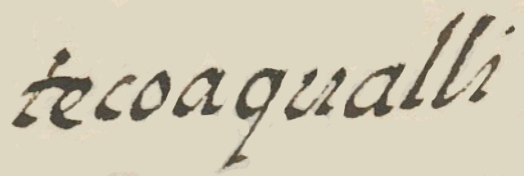
tecoaqualli
tecoacualli
Stephanie Wood
1577
Jeff Haskett-Wood
mordeduras, serpientes, remedios, salud, tecnología, cuchillo, tijeras, petates, hombres, serpientes, víbora, víboras, culebra, culebras

tecoacual(li), a snakebite, https://nahuatl.wired-humanities.org/content/tecoacualli
la mordedura de serpiente
Stephanie Wood
Available at Digital Florentine Codex/Códice Florentino Digital, edited by Kim N. Richter and Alicia Maria Houtrouw, "Book 11: Earthly Things", fol. 80v, Getty Research Institute, 2023. https://florentinecodex.getty.edu/en/book/11/folio/80v/images/0 Accessed 16 October 2025.
Images of the digitized Florentine Codex are made available under the following Creative Commons license: CC BY-NC-ND (Attribution-NonCommercial-NoDerivs 4.0 International). For print-publication quality photos, please contact the Biblioteca Medicea Laurenziana ([email protected]). The Library of Congress has also published this manuscript, using the images of the World Digital Library copy. “The Library of Congress is unaware of any copyright or other restrictions in the World Digital Library Collection. Absent any such restrictions, these materials are free to use and reuse.”