Tecolol (MH504r)
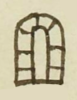
This simplex glyph for the personal name Tecolol ("Stone Arch," attested here as a man's name) shows a frontal view of a stone arch (tecololli) with large, cut stones and a smaller one at the top and center. The entry way is shaded to look dark, as though open but leading to a dark interior.
Stephanie Wood
The shading suggests European artistic influence. Juan José Batalla points out how a curving arched doorway, sometimes called tecololli in Nahuatl (and notes how perhaps tolcalli would be more appropriate), is a European architectural introduction. See: "Análisis de elementos gráficos de contenido occidental en los glifos de los códices coloniales del Centro de México: el caso de los antropónimos nahuas," in El arte de escribir. El Centro de México: del Posclásico al siglo XVII, eds. Juan José Batalla Rosado and Miguel Ángel Ruz Barrio (Zinacantepec, Estado de México: El Colegio Mexiquense, A. C., 2018), 84.]
Below, see another stone arch (but with a somewhat different name) and a triangular arch.
Stephanie Wood

Juan
tecolol
Juan Tecolol
Stephanie Wood
1560
Jeff Haskett-Wood and Stephanie Wood
This could be considered a compound if we count the stones [te(tl)] and the arching shape [colol(li)] as two separate (although merged) elements.
arches, arcos, stones, piedras, nombres de hombres, men's names
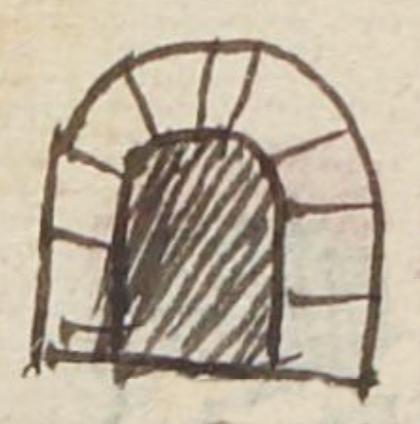
tecolol(li), stone arch, https://nahuatl.wired-humanities.org/content/tecololli
coltic, curved, bent, https://nahuatl.wired-humanities.org/content/coltic
Arco de Piedra
Stephanie Wood
Matrícula de Huexotzinco, folio 504r, https://www.loc.gov/resource/gdcwdl.wdl_15282/?sp=87&st=image
This manuscript is hosted by the Library of Congress and the World Digital Library; used here with the Creative Commons, “Attribution-NonCommercial-ShareAlike 3.0 License” (CC-BY-NC-SAq 3.0).