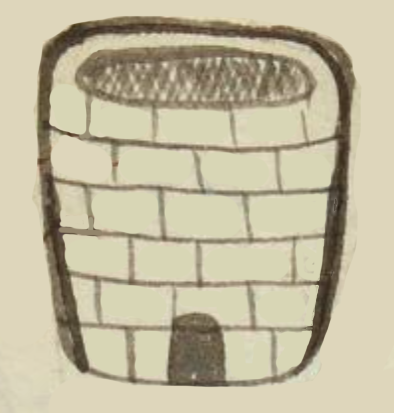
Tenexcalco (MH779v)
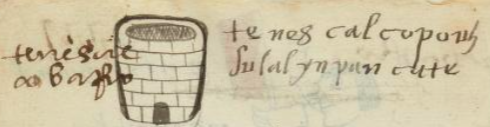
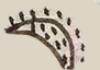
This black-line drawing of the simplex glyph for the place name Tenexcalco ("At the Lime Kiln") shows a frontal view of a circular, bucket-shaped lime kiln. It is made of stone or adobe bricks that are stacked in a standard "running bond" pattern (in European masonry terms). A small, open, black, arching doorway appears at ground level. The top is wider than the base. The top has an oval opening, either shaded or with a mesh covering it.
Stephanie Wood
The phrase captured with the gloss field refers to a solar (lot) or solares, which could refer to the house lots of the inhabitants of the barrio or perhaps a lot where lime kilns are located.
Juan José Batalla points out how the curving arched doorway, sometimes called tecololli in Nahuatl (and notes how perhaps tolcalli would be more appropriate), is a European architectural introduction. See: "Análisis de elementos gráficos de contenido occidental en los glifos de los códices coloniales del Centro de México: el caso de los antropónimos nahuas," in El arte de escribir. El Centro de México: del Posclásico al siglo XVII, eds. Juan José Batalla Rosado and Miguel Ángel Ruz Barrio (Zinacantepec, Estado de México: El Colegio Mexiquense, A. C., 2018), 84.]
Stephanie Wood
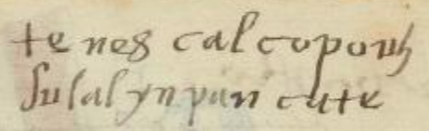
tenescalco pouh Sulal ynpan cate
Tenexcalco pouh solar inpan cateh
Stephanie Wood
1560
Jeff Haskett-Wood
barrios, pueblos, cal, arquitectura, nombres de lugares
tenexcal(li), lime kiln, https://nahuatl.wired-humanities.org/content/tenexcalli
-co (locative suffix), at, or in, https://nahuatl.wired-humanities.org/content/co
Lugar del Horno de Cal
Stephanie Wood
Matrícula de Huexotzinco, folio 779v, World Digital Library, https://www.loc.gov/resource/gdcwdl.wdl_15282/?sp=633&st=image.
This manuscript is hosted by the Library of Congress and the World Digital Library; used here with the Creative Commons, “Attribution-NonCommercial-ShareAlike 3.0 License” (CC-BY-NC-SAq 3.0).