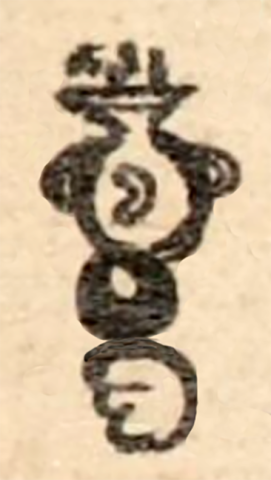
Tepalecoc (Verg55r)
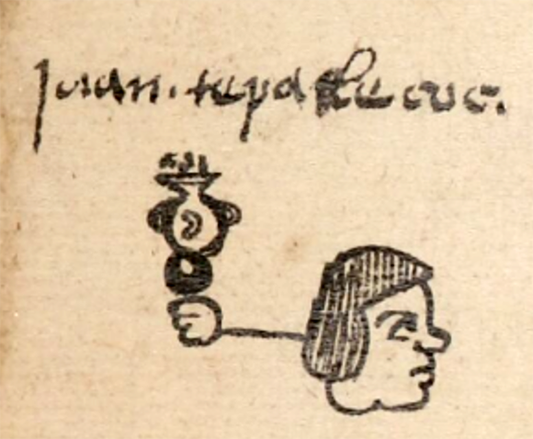
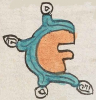
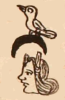
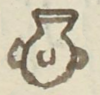
This compound Nahuatl hieroglyph is a black-line drawing of the personal name Tepalecoc, attested here as a man’s name. Gordon Whittaker translates it as, “He Arrived With Someone’s Help.” The compound is a column of signs, read from bottom up. At the bottom is a lower portion of a face. While the chin is prominent, it is the lips (tentli) that are featured, providing the phonetic syllable at the start to the name Te-. Next is a black (palli) bean (etl), supplying the -pal- and -e- syllables in the middle of the name. Next comes a jug (comitl), contributing the -co- syllable. The compound concludes with the pulque (octli) foam bubbling out of the top of the jug and providing the phonetic syllable -oc- at the conclusion of the name.
Stephanie Wood
Gordon Whittaker (2021, 152) has analyzed this compound, noting how “each of the signs in the name Tepalecoc has a syllabic value derived from a logographic one: te2 from TEN(TLI), ‘lip(s),’ pal from PAL(LI), ‘black dye,’ e from E(TL), ‘bean,’ co from COM(ITL), ‘jug,’ and oc from OC(TLI), ‘pulque.’” Whittaker notes that these syllables are sequentially organized in columns that read much like cuneiform. Furthermore, the syllables can have a variety of constructions: CV (consonant-vowel), CVC (cosonant-vowel-consonant), V (vowel alone), and VC (vowel-consonant). Given how common such logosyllabic constructions are, especially in manuscripts from the Tetzcoco area, this example is especially compelling for showing that Nahuatl signs are hieroglyphs and not just pictographs or ideograms. Below we provide examples to compare with the elements of this Topalecoc compound.
Stephanie Wood

juan. tepalecoc.
Juan Tepalecoc
Stephanie Wood
1539
Jeff Haskett-Wood
labios, color negro, frijol, frijoles, barro, pulque, nombres de hombres, men’s names, fonetismo, earthenware, ceramic, ceramics, cerámicas, jug, pot, olla, jarra, jarro, vessel, vessels, vasija de cerámica, cántaro, cántaros, xoctli, xoctepi, huicolli, atlacuihuani, tecomitl, tecontontli, apilolli
ten(tli), lip(s), https://nahuatl.wired-humanities.org/content/tentli
pal(li), black, https://nahuatl.wired-humanities.org/content/palli
e(tl), bean(s), https://nahuatl.wired-humanities.org/content/etl
com(itl), jug, https://nahuatl.wired-humanities.org/content/etl
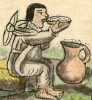
oc(tli), pulque, https://nahuatl.wired-humanities.org/content/pulque
Él Que Llegó Con La Ayuda de Alguien, o Sobreviviente, o Auxiliar
Stephanie Wood
Available at Codex Vergara, folio 55r, https://gallica.bnf.fr/ark:/12148/btv1b84528032/f117.item.zoom, accessed 25 March 2026. The Vergara is associated with Tepetlaoztoc, in the larger region of Tetzcoco, c. 1539–1543. “Source gallica.bnf.fr / BnF.” We would also appreciate a citation to the Visual Lexicon of Aztec Hieroglyphs, https://aztecglyphs.wired-humanities.org/.
Image Rights: The non-commercial reuse of images from the Bibliothèque nationale de France is free as long as the user is in compliance with the legislation in force and provides the citation: “Source gallica.bnf.fr / Bibliothèque nationale de France” or “Source gallica.bnf.fr / BnF.” We would also appreciate a citation to the Visual Lexicon of Aztec Hieroglyphs, https://aztecglyphs.wired-humanities.org/