tepohualli (TK211v)
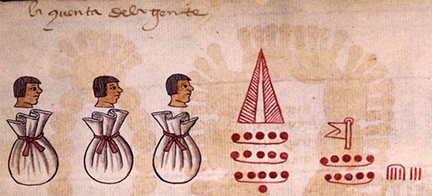
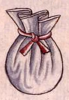
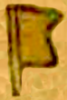
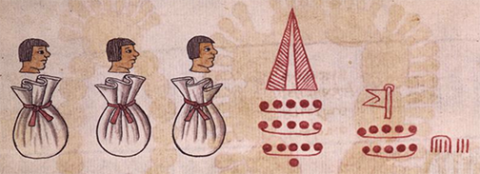
This painted example of notation in Nahuatl represents a population count (tepohualli) of 30,608 people, apparently the size of the full altepetl of Tepetlaoztoc. It is like a math equation. First, starting on the left, there are three rounded sacks we could call xiquipilli (8,000 each), for a subtotal of 24,000. The sacks are tied and have folds that make them three-dimensional, a style taught by European instructors. Above each one is a man’s head in profile, looking to the right. The Spanish-language gloss supports this by referring to “the count of the people,” which is a perfect translation for tepohualli, even though the Nahuatl term does not appear on the page. Next, the notation shows sixteen dots below what seems to be a triangular tip of a feather (probably a centzontli or tzontli, a count of 400), for another subtotal of 6,400. The running total is now 30,400. Added to that is a swallowtail-shaped flag (which would here possibly be called a tecpantli, standing for 20) with the multiplier of ten ones, which pushes the running total to 30,600. Finally, the eight ones are shown as vertical lines, grouped as five plus three. The grand total is, therefore, 30,608, which is supported by the text that spells the number out fully in Spanish: “treynta mill y seyscientos y ocho.”
Stephanie Wood
A population census will not always spell out whether the count is individuals or households. A census from Morelos [The Book of Tributes, ed. and transl. S. L. Cline, (1993), 220–221], however, delightfully explains that the count of 974 in one community included “tribute payers, women, children, young men, young women, [and] widows.” This census from Tepetlaoztoc shows only men, probably tribute payers or heads of households (a concept possibly introduced by the colonizers). On folio 212v, a similar count refers to the men as “vos” (vecinos, residents). The visual counts from Tepetlaoztoc on both folios 211v and 212v are not simply notations, but they are also simplex hieroglyphs. Note how ones can be dots or short vertical lines. Also, it is important to see how both addition and multiplication come into play in the equation. Finally, in this case, the equation moves from left to right, starting with the larger units and continuing to the smaller measures. This manuscript was produced as part of the community’s resistance to the unreasonable taxation being demanded vis-a-vis the size of the community, especially as the population was declining as a result of diseases inadvertently brought over from Europe.
Side Note: The folio numbers are not always clear in the copy published online by the British Museum. Marc Thouvenot gives this page the number K09_B in his TLACHIA digital collection, https://tlachia.iib.unam.mx/tepetlaoztoc/K09_B.
Stephanie Wood

la quenta dela gente
la cuenta de la gente
Stephanie Wood
c. 1556
Jeff Haskett-Wood
censos, censuses, población, contar gente, demography, demografía, banner, banners, bandera, banderas, pluma, plumas, costal, costales, alforja, alforjas, bolsa, bolsas, tlacatlacuilolli, colonialismo, resistencia
tzon(tli), 400, https://nahuatl.wired-humanities.org/content/tzontli
centzontli, 400, https://nahuatl.wired-humanities.org/content/centzontli
xiquipil(li), 8,000, https://nahuatl.wired-humanities.org/content/xiquipilli
tecpan(tli), twenty, https://nahuatl.wired-humanities.org/content/tecpantli
el censo
Stephanie Wood
The Codex Kingsborough, also known as the Códice de Tepetlaoztoc, and the Memorial de los indios de Tepetlaoztoc, is not on display. It was transferred from the British Library and is now held by the British Museum. It is shared on line at: https://www.britishmuseum.org/collection/object/E_Am2006-Drg-13964
©The Trustees of the British Museum. Shared under a Creative Commons Attribution-Non-Commercial-ShareAlike 4.0 International (CC BY-NC-SA 4.0) license. Please also cite the <em>Visual Lexicon of Aztec Hieroglyphsem>, ed. Stephanie Wood (Eugene, Ore.: Wired Humanities Projects, 2020-present) and this URL.