Tetzcuin (MH896r)
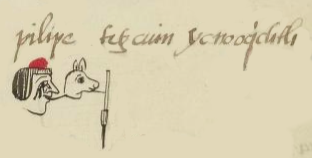
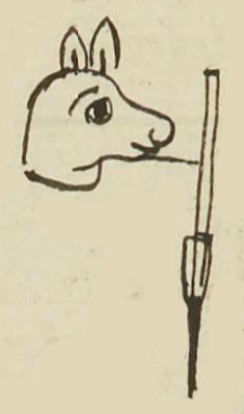
This black-line drawing of the compound Nahuatl hieroglyph for the personal name Tetzcuin (perhaps “Stone-Dog” or maybe “Ugly Thing”) is attested here as a man’s name. The glyph shows the head of a white dog (an itzcuintli) in profile, looking right. A line from the dog’s mouth connects to a vertical, point-down, writing implement. This implement has some interesting detail that is not found on all such tools. There is nothing in the visuals here that suggests “stone” (tetl) or even an ugly deformed thing (tetzcuino). So, a neat translation remains elusive.
Stephanie Wood
Este dibujo de trazos negros del jeroglífico compuesto náhuatl utilizado para designar el nombre propio Tetzcuin (quizá “Perro Pétreo” o hasta “Cosa Horrenda”) se registra aquí como el nombre de un hombre. El glifo nos muestra la cabeza de un perro blanco (un itzcuintli) de perfil que mira hacia la derecha. Una línea que parte de la boca del can lo conecta con un utensilio de escritura vertical que apunta hacia abajo, el cual está plasmado con detalles interesantes que no se encuentran en todas las representaciones de estos adminículos. No hay elemento alguno en la imagen que sugiera una “piedra” (tetl) o una cosa horrenda o deforme (tetzcuino), por lo cual es difícil alcanzar una traducción concreta.
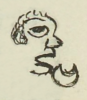
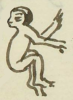
If stone-dog is meant, perhaps the name refers to a stone carving of a dog. If tetzcuino (ugly or deformed thing) is meant, see a couple of examples of hieroglyphs below that seem to suggest some type of deformity. Perhaps surprisingly, having some kind of physical abnormality could have been a plus. Ben Leeming has written about people with deformities in Nahua culture as "morally neutral, supernaturally powerful, and ultimately essential members of the Mesoamerican sacred realm." [See: “‘Big-Old Long Lips’, ‘Big-Old Jar Nose’: Ancient Mesoamerican Monsters and Clowns and the Transformation of Christianity in Early Colonial Mexico," Ancient Mesoamerica 33:2 (Summer 2022).]
Stephanie Wood
Si se deseaba referirse a Perro Pétreo, quizá el nombre se refiera al tallado en piedra de un can; pero si se deseaba referirse a tetzcuino (cosa horrenda o deforme), véase más abajo un par de ejemplos de jeroglíficos que parecen sugerir una cierta deformidad. Also sorprendente es que tener una anormalidad física podría haber sido una ventaja: Ben Leeming ha escrito que las personas con deformidades en la cultura nahua eran “moralmente neutras, tenían poderes sobrenaturales y eran, en definitiva, miembros fundamentales del ámbito sagrado mesoamericano”: véase “‘Big-Old Long Lips’, ‘Big-Old Jar Nose’: Ancient Mesoamerican Monsters and Clowns and the Transformation of Christianity in Early Colonial Mexico", Ancient Mesoamerica 33:2 (Summer 2022).
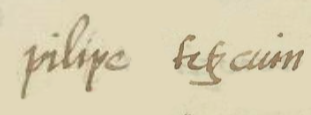
pilipe tetzcuin, ycnooq~chtli
Felipe Tetzcuin, icnooquichtli
Stephanie Wood
1560
Jeff Haskett-Wood
diformes, piedras, perros, itzcuintles, cosas feas, nombres de hombres
tetzcuino, an ugly deformed thing, https://nahuatl.wired-humanities.org/content/tetzcuino
itzcuin(tli), a Mexican dog, https://nahuatl.wired-humanities.org/content/itzcuintli
te(tl), stone, https://nahuatl.wired-humanities.org/content/tetl
posiblemente, Piedra-Itzcuintli, o tal vez Cosa Fea
Stephanie Wood
Matrícula de Huexotzinco, folio 896r, World Digital Library, https://www.loc.gov/resource/gdcwdl.wdl_15282/?sp=864&st=image.
This manuscript is hosted by the Library of Congress and the World Digital Library; used here with the Creative Commons, “Attribution-NonCommercial-ShareAlike 3.0 License” (CC-BY-NC-SAq 3.0).