Teucmicqui (MH491v)
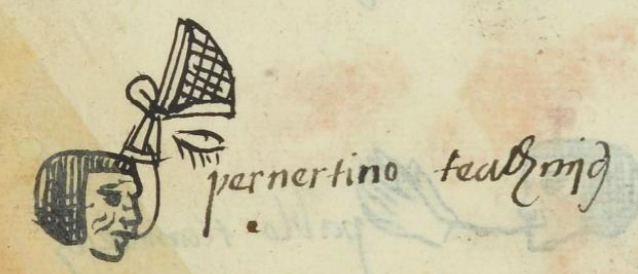
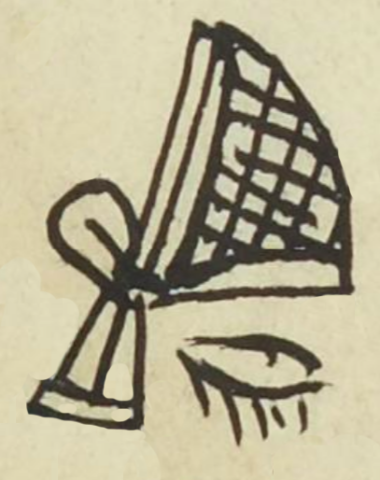
This black-line drawing of the compound glyph for the personal name Teucmicqui (here, attested as male) has two prominent elements. One is the diadem that represents the word for lord teuctli or tecuhtli. It is shown here in profile, facing toward the viewer's right. The diadem has pattern of mesh-like intersecting lines across the main part, and it has a tie at the back. The other element, to the right of the diadem, is a human eye that is closed, representing a dead person (micqui). The closed eye has prominent lashes across the bottom of the eye, suggesting the eyelid is closed.
Stephanie Wood
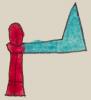
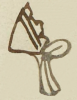
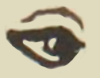
The effect of this name might be Lord-Deceased. For other examples of diadems representing the word teuctli, see below. To compare the closed eye with an open one from this same codex, see also below.
Stephanie Wood

pernertino tecuhmiq~
Bernardino Tecuhmicqui (or Teucmicqui)
Stephanie Wood
1560
Xitlali Torres and Stephanie Wood
eyes, ojos, diadems, diademas, crowns, coronas
teuctli, a lord, https://nahuatl.wired-humanities.org/content/teuctli.
El Señor Muerto
Stephanie Wood
Matrícula de Huexotzinco, folio 491r, World Digital Library, https://www.loc.gov/resource/gdcwdl.wdl_15282/?sp=62&st=image.
This manuscript is hosted by the Library of Congress and the World Digital Library; used here with the Creative Commons, “Attribution-NonCommercial-ShareAlike 3.0 License” (CC-BY-NC-SAq 3.0).