Tlacochin (MH668r)
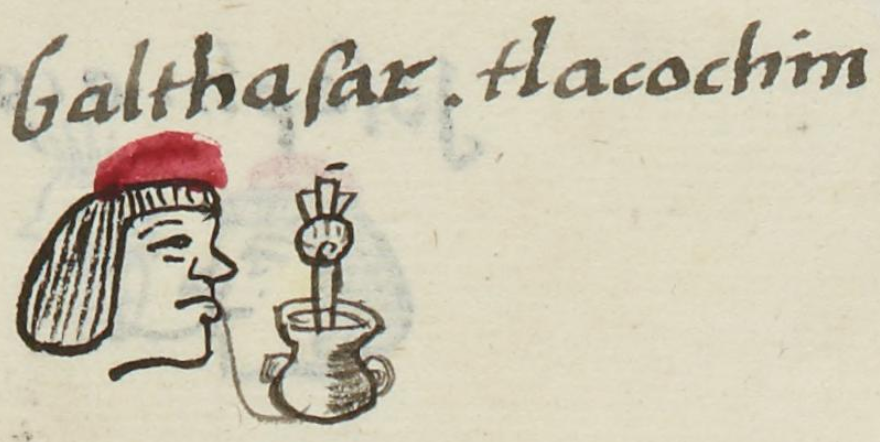
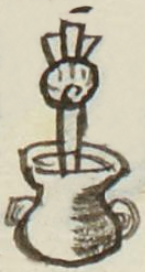
This black-line drawing of the compound Nahuatl hieroglyph for the personal name Tlacochin (an older form of tlacochtli), which translates as "Javelin," is attested here as a man’s name. The glyph shows an upright, fletched projectile (tlacochtli) coming out of the top of a ceramic jug (comitl). The point is not visible, down inside the jug, which has some shading that gives it a three-dimensionality (revealing European artistic influence). The jug is a phonetic indicator for the -co- in the middle of the name.
Stephanie Wood
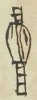
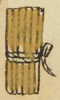
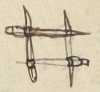
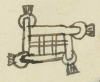
The tlacochin looks much like a mitl, with the feather decorations. Sometimes, however, the tlacochin projectiles are crossed or put in a rectangular arrangement.
Stephanie Wood

balthasar.tlacochin
Baltazar Tlacochin
Stephanie Wood
1560
Jeff Haskett-Wood
arrows, flechas, lanza, jabalina, nombres de hombres, men's names, fonetismo, earthenware, ceramic, ceramics, cerámicas, jug, pot, olla, jarra, jarro, vessel, vessels, vasija de cerámica, cántaro, cántaros, xoctli, xoctepi, huicolli, atlacuihuani, tecomitl, tecontontli, apilolli
tlacoch(tli), a javelin, https://nahuatl.wired-humanities.org/content/tlacochtli
Tlacochin, famous person's name, https://nahuatl.wired-humanities.org/content/tlacochin
posiblemente, Flecha o Lanza
Stephanie Wood
Matrícula de Huexotzinco, folio 668r, World Digital Library, https://www.loc.gov/resource/gdcwdl.wdl_15282/?sp=416&st=image.
This manuscript is hosted by the Library of Congress and the World Digital Library; used here with the Creative Commons, “Attribution-NonCommercial-ShareAlike 3.0 License” (CC-BY-NC-SAq 3.0).