Tlacochtemoc (Verg33v)
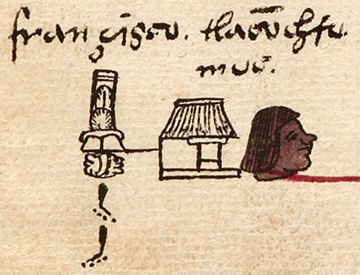
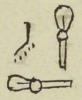
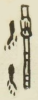
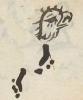
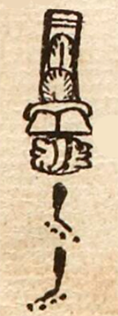
This compound Nahuatl hieroglyph is a black-line drawing of the personal name Tlacochtemoc (perhaps, “Lance Descended”). The elements of the compound include two front teeth (tlantli), representing the complementary Tla- syllable that starts the name. Above the teeth is the top of a tlacochin, decorated with a wing feather and a down feather, providing the main semantic element of the name. Below the teeth is a stone (tetl), which provides the -te- syllable and the phonetic start to the suffix. Finally, below the stone are two alternating foodprints, referring to the descent (-temoc). Other very similar compound glyphs for a Francisco Tlacochte[m]oc appears on folio 35r and folio 37r.
Stephanie Wood
The use of the suffix -temoc (descended) on personal names is quite widespread. We have at least three examples of Tlacochtemoc from the Matrícula de Huexotzinco. Tlacochtemoc has also been attested as a man’s name in Cuernavaca, as shown in our Online Nahuatl Dictionary, so it crosses regional lines. The most famous name of this type is Cuauhtemoc, referring to a descending eagle. The use of descending footprints is a very common iconographical element in these compound names with -temoc.
Stephanie Wood
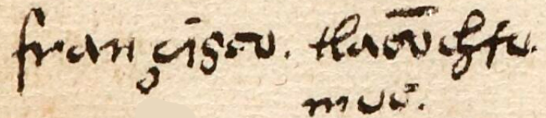
françisco. tlacochtemoc.
Francisco Tlacochtemoc
Stephanie Wood
1539
Jeff Haskett-Wood
lanzas, jabalina, jabalinas, descender, bajar, nombres de hombres, men’s names
tlacochin, lance, spear, or javelin, https://nahuatl.wired-humanities.org/content/tlacochin
temo, to descend, https://nahuatl.wired-humanities.org/content/temo
La Lanza Descendió
Stephanie Wood
Available at Codex Vergara, folio 33v, https://gallica.bnf.fr/ark:/12148/btv1b84528032/f74.item.zoom, accessed 1 March 2026. The Vergara is associated with Tepetlaoztoc, in the larger region of Tetzcoco, c. 1539–1543. “Source gallica.bnf.fr / BnF.” We would also appreciate a citation to the Visual Lexicon of Aztec Hieroglyphs, https://aztecglyphs.wired-humanities.org/.
Image Rights: The non-commercial reuse of images from the Bibliothèque nationale de France is free as long as the user is in compliance with the legislation in force and provides the citation: “Source gallica.bnf.fr / Bibliothèque nationale de France” or “Source gallica.bnf.fr / BnF.” We would also appreciate a citation to the Visual Lexicon of Aztec Hieroglyphs, https://aztecglyphs.wired-humanities.org/