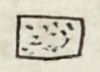
tlalmilli (TK217r)
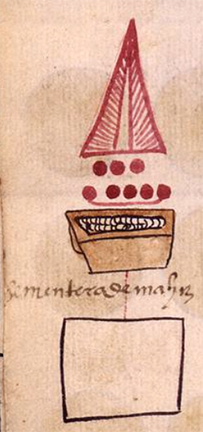
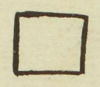
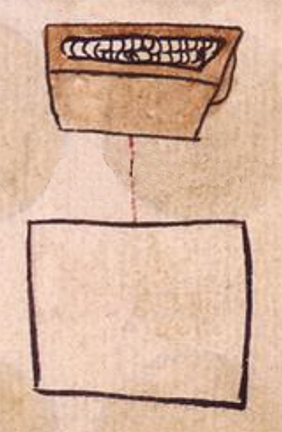
This painted example of iconography refers to a parcel of land that was to be planted in maize (what we are giving the label tlalmilli, which seems to align with the Spanish gloss and it concurs with the reading by Marc Thouvenot in TLACHIA, https://tlachia.iib.unam.mx/tepetlaoztoc/K15_A). The land is represented by the rectangle simply drawn with a black line. Above it is a brown trapezoidal container (likely a measure of corn kernels, such as a fanega or an almud, both Spanish terms that entered Nahuatl). The corn kernels are visible in black and white looking over the rim of the wooden container. The colonial overlord (an encomendero in this case, who held a grant to extract tribute in kind and labor from the Nahua community) was expecting to be paid the huge sum of 3,200 loads of maize from the pueblo’s agricultural landholdings. This manuscript was produced as part of the community’s resistance to the unreasonable taxation being demanded vis-a-vis the size of the community, especially as the population was declining as a result of diseases inadvertently brought over from Europe.
Stephanie Wood
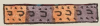
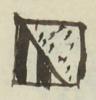
This iconographic example is close to being a compound hieroglyph, but without a gloss, we are unsure of its specific reading even as we think we know its general meaning. Apparently, it is fully logographic. Above the measure of maize kernels is the notation of eight ones (grouped as five circles filled in with red paint and connected with a horizontal line, and three more above the five) as a multiplier for the red feather or tree (perhaps called a centzontli) which represents the number 400. Hieroglyphs for tlalli and milli are typically drawn as rectangles, sometimes just as an empty rectangle, and sometimes segmented, dotted, painted two colors, and so on. See below.
Side Note: The folio numbers are not always clear in the copy published online by the British Museum. Marc Thouvenot gives this page the number K15_A in his TLACHIA digital collection, https://tlachia.iib.unam.mx/tepetlaoztoc/K15_A.
Stephanie Wood
sementera de mahiz
sementera de maíz
Stephanie Wood
c. 1556
Jeff Haskett-Wood
sementeras, fanegas, almudes, tierras, agricultura, tributos, encomienda, encomenderos, medir, rectángulo, rectángulos, parcela, parcelas, tlalli, milli, tributo, tributos, colonialismo, resistencia
tlalmil(li), an agricultural parcel usually planted in maize, https://nahuatl.wired-humanities.org/content/tlalmilli
la sementera de maíz
Stephanie Wood
The Codex Kingsborough, also known as the Códice de Tepetlaoztoc, and the Memorial de los indios de Tepetlaoztoc, is not on display. It was transferred from the British Library and is now held by the British Museum. It is shared on line at: https://www.britishmuseum.org/collection/object/E_Am2006-Drg-13964
©The Trustees of the British Museum. Shared under a Creative Commons Attribution-Non-Commercial-ShareAlike 4.0 International (CC BY-NC-SA 4.0) license. Please also cite the <em>Visual Lexicon of Aztec Hieroglyphsem>, ed. Stephanie Wood (Eugene, Ore.: Wired Humanities Projects, 2020-present) and this URL.