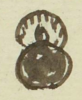
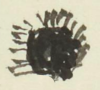
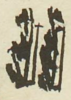
Tlilpotonqui (TK205r)
This simplex Nahuatl hieroglyph stands for the personal name Tlilpotonqui, which could be translated as a black feather device or a rare type of bean. Here, it appears to involve a grouping of four black (tlilli) round balls or circular objects. The name is attested here as pertaining to a man.
Stephanie Wood
In this case the personal name refers to a Nahua ruler of Tepetlaoztoc (spelled Tepetlaoxtoc today). The full page in the codex shows tributes paid, along with the wives, children, and the grandchildren of this man, all drawn in the form of a genealogy. He was baptized Diego and given the honorific “don,” which entered Nahuatl from the Spanish language. The contextualizing image shows don Diego wearing a colorful cloak (surely called a tilmatli, although the term is not used in the companion text) with an elaborate flower design. His children and wives are all dressed in finery, too. He is seated on a woven throne (surely called an icpalli).
The term tlilpotonqui, when entered in the Quick Search, will produce a wide range of diverging visual hieroglyphic elements. Some are round black objects, perhaps rubber balls, which could serve as a phonetic syllable, tlil- (black). Others look like they could involve sticks with black feathers or twisted grass blades. But the definitive assessment is still elusive. See some examples below.
Side Note: The folio numbers are not always clear in the copy published online by the British Museum. Marc Thouvenot gives this page the number K03_A in his TLACHIA digital collection, https://tlachia.iib.unam.mx/tepetlaoztoc/K03_A.
Stephanie Wood
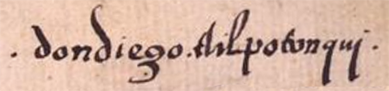
. don diego . tlilpotonqui .
Don Diego Tlilpotonqui
Stephanie Wood
c. 1556
Jeff Haskett-Wood
gobernador, jerarquía, tributo, tributos, genealogía, divisas, plumas, frijoles, ropa, textiles, nombres de colores, nombres de hombres

tlilpotonqui, a black feather device or a rare bean, also a personal name, https://nahuatl.wired-humanities.org/content/tlilpotonqui
A. C. Breton ["Some Mexican Picture-Names," Man 64 (August 1919), 118] suggests: "dark and sweet-smelling."
(una divisa hecha de plumas negras, o un frijol raro)
Stephanie Wood
The Codex Kingsborough, also known as the Códice de Tepetlaoztoc, and the Memorial de los indios de Tepetlaoztoc, is not on display. It was transferred from the British Library and is now held by the British Museum. It is shared on line at: https://www.britishmuseum.org/collection/object/E_Am2006-Drg-13964
©The Trustees of the British Museum. Shared under a Creative Commons Attribution-Non-Commercial-ShareAlike 4.0 International (CC BY-NC-SA 4.0) license. Please also cite the <em>Visual Lexicon of Aztec Hieroglyphsem>, ed. Stephanie Wood (Eugene, Ore.: Wired Humanities Projects, 2020-present) and this URL.