Xonoctla (Mdz51r)
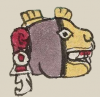
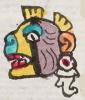
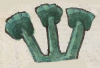
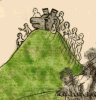
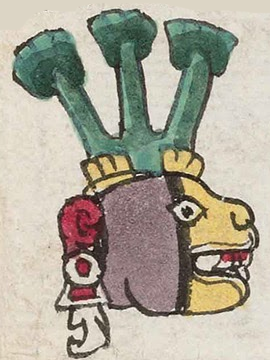
This compound Nahuatl hieroglyph for the place name Xonoctlan has two principal elements. At the top are three trunks or branches representing the xonotl) tree. The multicolored, anthropomorphized, dog-like head below the tree appears to be a phonetic reinforcement, intending to elicit the divine force or deity name, Xolotl, a near homophone. The locative suffix (-tla, -tlah, or -tlan, if the final "n" has been inadvertently dropped) is not shown visually. Representations of Xolotl often have sharp teeth and wrinkled faces, recalling the xoloitzcuintli, native Mexican dog.
Stephanie Wood
Este jeroglífico compuesto náhuatl para el topónimo Xonoctlan cuenta con dos elementos principales: en la parte superior aparecen tres troncos o ramas que representan al árbol xonotl (jonote). La cabeza de cánido antropomorfo multicolor debajo del árbol parece fungir como un refuerzo fonético que evoca el nombre de la entidad divina o deidad Xolotl, un homófono casi perfecto. El sufijo locativo (-tla, -tlah o -tlan si se ha omitido por descuido la n final) no aparece de manera visual. Se representa frecuentemente a Xolotl con colmillos afilados y rostro arrugado, lo cual nos recuerda al xoloitzcuintli, el perro nativo mexicano.
One wonders whether the "c" in Xonoctla should be there, if the place name is mainly intending to speak of a place known for the xonotl tree. Sometimes the spelling is Xonotla. See The Essential Codex Mendoza, eds. Frances F. Berdan and Patricia Rieff Anawalt, 1997, p. 128.
In this digital collection, face paint or tattooing has ethnic associations, involving Chichimecs, the Otomí, the Tlaxcalteca, and those who were “different” (e.g. the Tlamaca or Tlamanca). Divine forces, such as Ecatl (or Ehecatl) and Xolotl, also have some face paint or tattoos.
Stephanie Wood
Nos preguntamos si la c en Xonoctla es correcta, en caso de que el topónimo indique principalmente un lugar conocido por su abundancia de ejemplares del árbol xonotl. A veces se encuentra la grafía Xonotla: véase The Essential Codex Mendoza, de Frances F. Berdan y Patricia Rieff Anawalt (eds.) (1997: 128).
En nuestra colección digital, la pintura o los tatuajes faciales son características asociadas con diferentes etnias, tales como los chichimecas, otomíes, tlaxcaltecas y los que eran “diferentes” (por ejemplo, los tlamacas o tlamancas). Las entidades divinas, tales como Ecatl (o Ehecatl) y Xolotl, también cuentan con ciertas pinturas o tatuajes faciales.
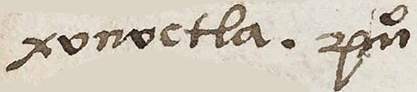
xonoctla. puo
Xonoctla, pueblo
Stephanie Wood
c. 1541, or by 1553 at the latest
Stephanie Wood
trees, árboles, deities, deidades, dogs, perros, nombres de lugares, fonetismo, place names

This photo of the xoloitzcuintli is hosted by Flickr, and Google marks it as having Creative Commons rights.
xono(tl), a type of tree, https://nahuatl.wired-humanities.org/content/xonotl
Xolo(tl), god of lightning and death, typically depicted as a dog-headed man, https://nahuatl.wired-humanities.org/content/Xolotl
xoloitzcuin(tli), a native Mexican (almost) hairless dog, https://nahuatl.wired-humanities.org/content/xoloitzcuintli
-tla (locative suffix), place of abundance of, https://nahuatl.wired-humanities.org/content/tla-1
-tlan (locative suffix), place, https://nahuatl.wired-humanities.org/content/tlan
Codex Mendoza, folio 51 recto, https://digital.bodleian.ox.ac.uk/objects/2fea788e-2aa2-4f08-b6d9-648c00..., image 112 of 118.
The Bodleian Libraries, University of Oxford, hold the original manuscript, the MS. Arch. Selden. A. 1. This image is published here under the UK Creative Commons, “Attribution-NonCommercial-ShareAlike 3.0 License” (CC-BY-NC-SA 3.0).