Tecuantepec (Mdz13v)
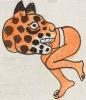
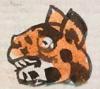
This compound glyph for the place name Tecuantepec (Tehuantepec today, meaning "At Jaguar Hill") has a ferocious wild animal (tecuan(i)) head resting on top of a mountain or hill (tepetl). The term tecuani refers to an animal that bites people). Its head is shown in profile view, facing the viewer's left. Its eyes and mouth are open, it is a terracotta-orange color, and it has black spots, like a jaguar. The mountain or hill is the usual two-tone green, bell shape with curly stone outcroppings on the slopes, and horizontal red and yellow stripes at the base. In the middle of the hill, or in front of it, is an upright red chilli (pepper) with a green stem. The locative suffix (-c) (as given in the gloss) is not shown visually by itself, but it combines with -tepe- to form -tepec, a visual locative suffix meaning "on the hill" or "on the mountain."
Stephanie Wood
Gordon Whittaker, in a presentation at the Library of Congress (18 April 2023), noted that the place name for Tecuantepec (or Tehuantepec) is a corruption of an original Zapotec place name, but there is a hill in the area that is indeed called Tecuantepec.
The chilli (pepper) in the middle of the tepetl does not play a phonetic role in the place name, but it may refer to the production of chilli (peppers) in the region.
Fernando Horcasitas observed in contemporary Nahua communities that the dancers who played the role of the tecuani are dressed as jaguars. See ocelotl in our Online Nahuatl Dictionary. Jaguar is generally considered the best modern translation for ocelotl, but the jaguar and the tecuani have been linked in the popular imagination for centuries. What is called the ocelot in English, is a smaller animal.
Stephanie Wood

tequantepec. puo
Tecuantepec, pueblo (Tehuantepec, today)
Stephanie Wood
c. 1541, or by 1553 at the latest
Stephanie Wood
mountains, hills, montañas, cerros, animales, tecuanes, jaguares, jaguars, chiles, nombres de lugares

tecuani, ferocious wild animal, literally one that bites people, https://nahuatl.wired-humanities.org/content/tecuani
cua, to eat or to bite, https://nahuatl.wired-humanities.org/content/cua
tepe(tl), hill or mountain, https://nahuatl.wired-humanities.org/content/tepetl
-tepec, on the hill or mountain, https://nahuatl.wired-humanities.org/content/tepec
Codex Mendoza, folio 13 verso, https://digital.bodleian.ox.ac.uk/objects/2fea788e-2aa2-4f08-b6d9-648c00..., image 37 of 188.
The Bodleian Libraries, University of Oxford, hold the original manuscript, the MS. Arch. Selden. A. 1. This image is published here under the UK Creative Commons, “Attribution-NonCommercial-ShareAlike 3.0 License” (CC-BY-NC-SA 3.0).