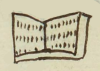
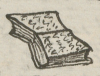
tlacuiloloni (FCbk11f221v)
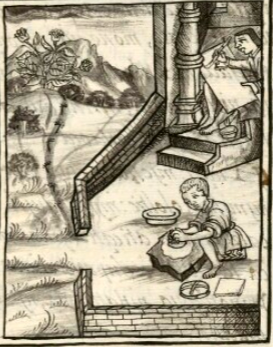
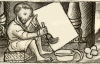
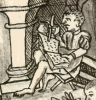
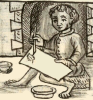
This iconographic example, featuring a substance used for painting and writing (tlacuiloloni), is included in this digital collection for the purpose of making comparisons with related hieroglyphs. The term selected for this example comes from the text near the image in the Digital Florentine Codex. There is no gloss, per se. This example shows a (probably Nahua) man seated on a stool (probably wooden), holding a large white rectangle (paper or a canvas) with his left hand. Below him is a bowl that contains the painting medium described by the term tlacuiloloni. In the man’s right hand he holds what appears to be a paintbrush. The tip of the implement is attached to the handle, and it bends where it hits the paper, as though it has bristles. But, it is not quite like the one on folio 217 verso, which is more certainly a brush. Near the man’s right hand, most interestingly, is a compound hieroglyph with a flag (panitl), and the flag’s post is sitting in water (atl). Might this intend apantli (canal)? The man has a standard Nahua man’s haircut, but he wears a collared, cuffed, probably belted, tunic, which is a garment that shows European stylistic influences. His feet are bare, which ensures he is not interpreted to be a Spaniard, even as he sits in a building with a European column right next to him. The clothing and the architecture all have shading and three-dimensionality, also showing European artistic influence.
Stephanie Wood
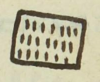
The excitement for the presence of an implement that seems like a paintbrush relates to the larger topic of the evolution in writing and painting that came with colonization. Even Nahua thinking about a separation of writing and painting which had been both described sufficiently with one word, such a icuiloa or tlacuiloa glyph, seems also to have become more distinguishable with the nature of the implement. Additional excitement arises here, where writing and painting on paper or canvas is represented by a hieroglyph. By the time of the Matrícula de Huexotzinco (1560) or the Florentine Codex (1570s), the iconography of writing typically shows short straight lines that are suggestive of alphabetic writing. However, this example of the act of painting (tlacuiloliztli) practically uniquely shows the recent act of creating a hieroglyph, not those little straight lines as seen in letrachihualoni and other examples, below, from 1560.
Stephanie Wood
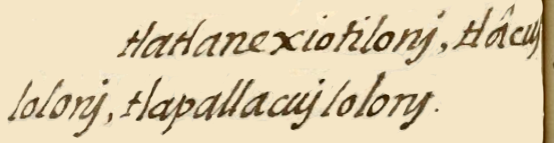
tlacujlolonj [or tlacuiloloni]
Stephanie Wood
1577
Jeff Haskett-Wood
escribiendo, pintando, medios, pinturas, pincel, pinceles, papel, lienzo, tela, glifo, glifos, jeroglífico, jeroglíficos
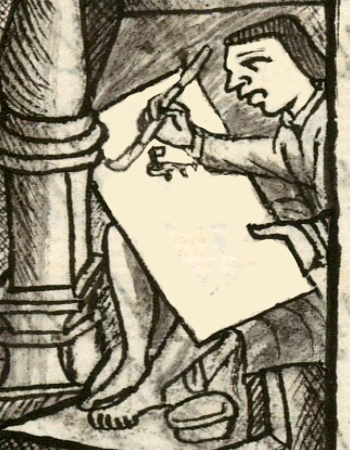
tlacuiloloni, a medium for painting and writing, https://nahuatl.wired-humanities.org/content/tlacuiloloni
un medio para pintar o escribir
Stephanie Wood
Available at Digital Florentine Codex/Códice Florentino Digital, edited by Kim N. Richter and Alicia Maria Houtrouw, "Book 11: Earthly Things", fol. 221v, Getty Research Institute, 2023. https://florentinecodex.getty.edu/en/book/11/folio/221v/images/0 Accessed 16 November 2025.
Images of the digitized Florentine Codex are made available under the following Creative Commons license: CC BY-NC-ND (Attribution-NonCommercial-NoDerivs 4.0 International). For print-publication quality photos, please contact the Biblioteca Medicea Laurenziana ([email protected]). The Library of Congress has also published this manuscript, using the images of the World Digital Library copy. “The Library of Congress is unaware of any copyright or other restrictions in the World Digital Library Collection. Absent any such restrictions, these materials are free to use and reuse.”