Atl Ihuetziyan (LTlaxUT1b)
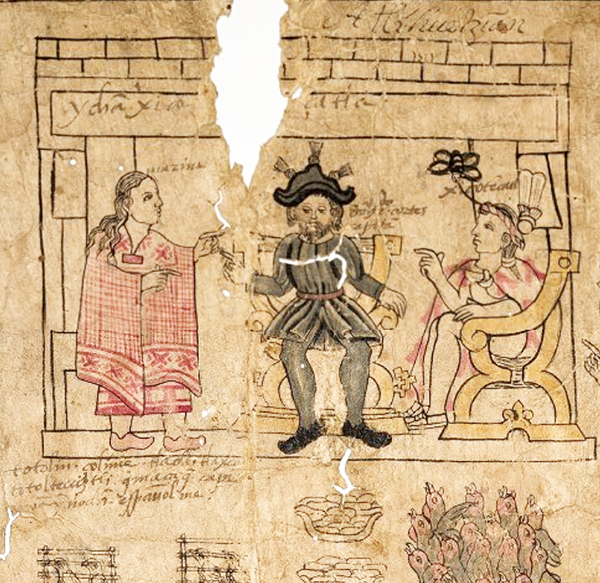
This iconographic example is included here for possible comparisons with Nahuatl hieroglyphs. It has as its focus a historic meeting that took place in Atl Ihuetziyan (“Water’s Customary Falling Place”) in the region of Tlaxcallan (Tlaxcala, today). At the center is “don Hernando Cortés, Capitán,” the leader of the Spanish expedition that was marching on Tenochtitlan in 1519. Here, he has stopped to meet with Xicotencatl (right), the lord of Tizapan, to discuss an alliance for taking power from the Aztecs in Tenochtitlan. On the left in this gathering is “Marina,” the Nahua interpreter that Cortés took onto his team at the Gulf Coast when he landed. The two men sit in curule chairs that would have been brought from Spain (and seem somewhat anachronistic for 1519, unless the expedition was carrying chairs for such purposes.). Marina stands, in almost a frontal view, but with her feet and head in profile, facing right. Her hair is long and wavy, falling over her shoulder and her back. She gestures with both hands, pointing both index fingers. Her clothing consists of a red and white handwoven blouse and skirt. The blouse has a mesh pattern with ornate borders containing X-shapes and little arrows pointing into the centers of the X-shapes. A rectangle reinforces the bottom of the V-neck of the blouse. Her shoes are red or pink. Cortés is the only person in this scene who sits in a frontal view. He wears a tunic that is black, slightly open below the waist, and has a red belt. He also wears dark gray leggings and black shoes. On his head is a black cap or hat with three tassels. Cortés is also gesturing with his right hand, pointing with his index finger. Xicotencatl wears a cape tied at the front, and he gestures with his right hand, pointing his index finger. There is a Nahuatl hieroglyph above and to the left of the head of Xicotencatl. The glyph is a bee (xicotli), representing the start of the lord’s name. While one note in Nahuatl indicates that this event takes place in Atl Ihuetziyan, another note in Nahuatl says the home of Xicotencatl is in Tizatlan.
Stephanie Wood
Marina was baptized with that name by the Spanish invaders. Her name evolved into Malintzin, because Nahuas found the “r” difficult to pronounce. They also added the honorific suffix (-tzin) to her name, because she had noble status. Interestingly, the Spaniards found it difficult to pronounce Malintzin, and the name finally became Malinche in Spanish.
Stephanie Wood
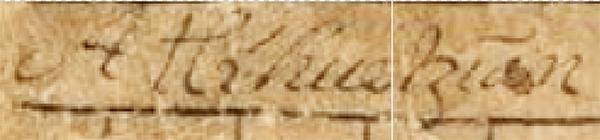
Atlihuetzĩan
Atl Ihuetziyan
Stephanie Wood
1540s
Jeff Haskett-Wood
pechero, mapilhuia, sillas, zapatos, sandalias, sombrero, glifo, tocado, plumas

Atl Ihuetziyan, a town, meaning the place where water customarily falls, https://nahuatl.wired-humanities.org/content/atl-ihuetziyan
a(tl), water, https://nahuatl.wired-humanities.org/content/atl
huetzi, to fall down, https://nahuatl.wired-humanities.org/content/huetzi
-yan, the place where something occurs or is done habitually, https://nahuatl.wired-humanities.org/content/yan
un pueblo en Tlaxcala
Stephanie Wood
Benson Latin American Collection, LLILAS Benson Latin American Studies and Collections, The University of Texas at Austin https://collections.lib.utexas.edu/catalog/utblac:3c754fd0-b27f-4af7-9cf...
The Benson Library has kindly provided the digital images and permission to put them into our Mapas Project in 2015. Use and reproduction from this project: https://creativecommons.org/publicdomain/mark/1.0/, but please also cite the Visual Lexicon of Aztec Hieroglyphs, ed. Stephanie Wood, (Eugene, Ore.: Wired Humanities Projects, ©2020-present). Version 1.0.