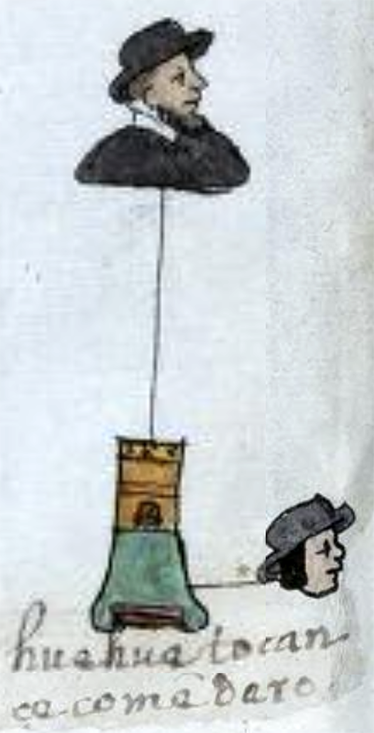
Huehuetoca (Osu34v)
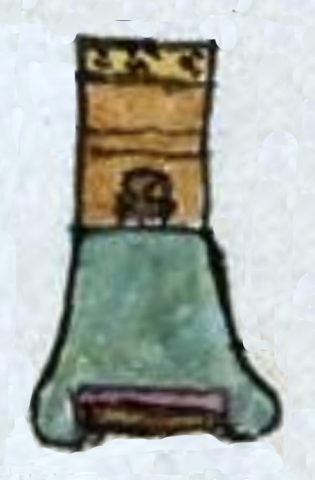
This painted compound Nahuatl hieroglyph represents a place name, Huehuetoca or Huehuetocan (spelled Huehuetoca today, and the translation remains elusive). The compound shows a standing drum (huehuetl), which serves as a phonetic indicator, perhaps, for old, patrimonial, or inherited. The drum is topped with a spotted jaguar skin. There is an opening between the two visible legs. This drum stands on top of a green, bell-shaped hill or mountain with the usual horizontal red and yellow stripes at its base, the place where spring water might emerge (as it does in various examples in this digital collection).
Stephanie Wood
The ending given in the Codex Azcatitlan does not have the final n, whereas the gloss for this one does. The letter "n" is typically either intrusive or dropping away inadvertently in Nahuatl anyway, so glosses are not necessarily helpful. Researching various scholars' analysis to see which is favored does not yet bring a satisfactory explanation. Some say the -toca in this place name is from the verb to bury or to follow. But the same people will say the -can is the locative suffix, and those elements do not seem to work together unless perhaps we double the "c". Some say the -toca in the place name is short for tocaitl, a name or names. If that is the case, there is no locative suffix (-can). One attestation in our entry for tocaitl in the Online Nahuatl Dictionary has ihuehuetoca with the added possessive at the front. Miguel León-Portilla and Sarah Cline translate that term as "his prehispanic name." Suggestions are welcomed.
Stephanie Wood
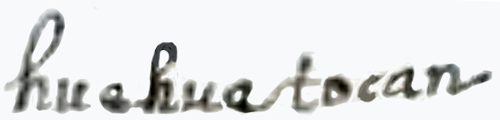
huehuetocan
Huehuetoca or Huehuetocan
Stephanie Wood
1551–1565
Jeff Haskett-Wood
drum, drums, tambor, tambores, place names, cerro, cerros, montaña, montañas, topónimo, topónimos, nombres de lugares, jaguar, jaguares, piel, pieles
huehuetoca(itl), origin of a lineage, https://nahuatl.wired-humanities.org/content/huehuetocaitl
huehue-, old, patrimonial, or inherited, https://nahuatl.wired-humanities.org/content/huehue
toca(itl), a name, https://nahuatl.wired-humanities.org/content/tocaitl
toca, to bury or plant, https://nahuatl.wired-humanities.org/content/toca
-can (locative suffix), where, https://nahuatl.wired-humanities.org/can-2
Library of Congress Online Catalog and the World Digital Library, Osuna Codex, or Painting of the Governor, Mayors, and Rulers of Mexico, https://www.loc.gov/resource/gdcwdl.wdl_07324/. The original is located in the Biblioteca Nacional de España.
"The Library of Congress is unaware of any copyright or other restrictions in the World Digital Library Collection. Absent any such restrictions, these materials are free to use and reuse." But please cite the Biblioteca Nacional de España and this Visual Lexicon of Aztec Hieroglyphs if you use any of these images here or refer to the content on this page, providing the URL