Ahuitzotl (Mdz13r)
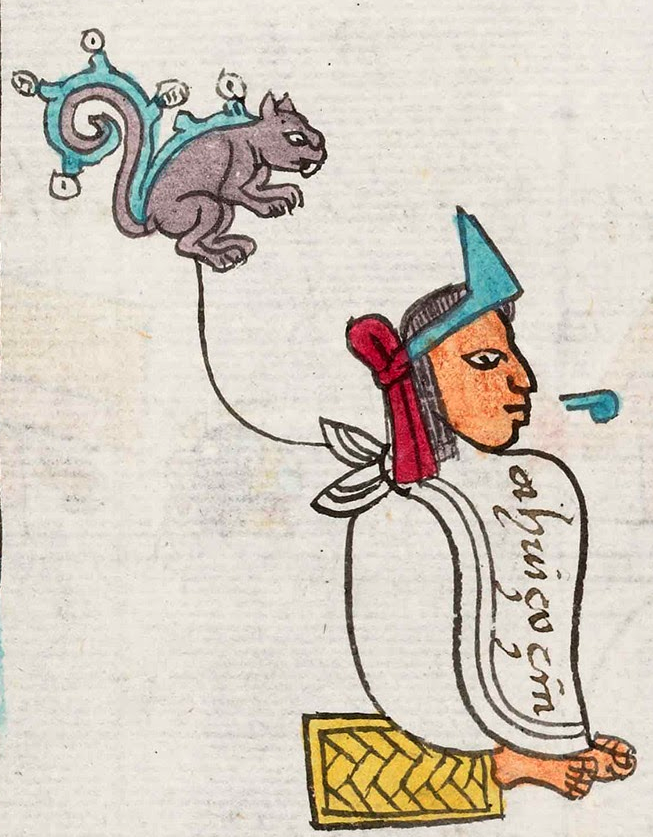
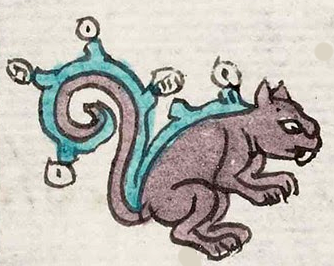
This compound Nahuatl hieroglyph for the personal name Ahuitzotl includes a stream of water (atl) wrapping around an amphibious animal that resembles a dog (ahuitzotl), according to Alonso de Molina. It may be an amphibious marsupial, but here it resembles a squirrel. The water is a phonetic complement that ensures that the animal is read as having a name that starts with A-. But the water is also semantic, given this is an aquatic animal, legendary for lying in waiting in the depths of the lake to drag swimmers down and drown them. The ahuitzotl is shown in profile, facing to the viewer's right. Its two front paws are in the air, and it sits on its two hind legs. It has a long tail that curls, with the stream of water curling right around the tail. The animal is painted a purple-gray. The water is a standard turquoise with lines of current, droplets, and turbinate shells splashing off of the stream.
Stephanie Wood
Este jeroglífico compuesto náhuatl utilizado para designar el nombre propio Ahuitzotl comprende un chorro de agua (atl) que se enrosca alrededor de un animal anfibio parecido a un perro (ahuitzotl), según Alonso de Molina; podría tratarse de un marsupial anfibio, pero en este caso se parece más a una ardilla. El agua es un complemento fonético que nos obliga a considerar que el animal cuenta con un nombre que empieza con a, pero también es un elemento semántico, dado que se trata de una fiera acuática, cuyas leyendas cuentan que se emboscaba en las profundidades del lago para apoderarse de los nadadores y hacerlos ahogarse. El ahuitzotl se muestra de perfil y mirando hacia la derecha del espectador, sentado sobre sus patas traseras y con las delanteras en el aire, con un largo rabo enroscado alrededor del cual se observa el chorro de agua. El animal está pintado de color morado grisáceo, mientras que el agua se representa con el clásico color turquesa con líneas de corrientes, gotas y conchas de forma helicoidal que caen del chorro.
There is disagreement around the translation of this glyph. Some reject ahuitzotl ("water dog") and suggest it is a homonym for the compound word that combines atl + huitztli + yotl. Ahuitzotl, the famous man who bore this name, was a governing lord of Mexico from the late fifteenth until just after the start of the sixteenth century. Note the comparison glyph carved in stone below, where the water similarly swirls around the animal, although not involving the tail. Both artists employ considerable skill and creativity in the drawing and the carving.
Marc Thouvenot's vignette about an image of Ahuitzotl from the Códice Matritense de la Real Academia includes a compound hieroglyph with a somewhat different-looking animal, but it does have the water glyph following the line of its back and spilling over its tail. See: https://vignettes.sup-infor.com/imagen/5-RA_01_051v_b.
Stephanie Wood
No hay un consenso sobre la traducción de este glifo: algunos estudiosos rechazan el lema ahuitzotl (“perro de agua”) y afirman que es un homónimo de la palabra compuesta que combina atl + huitztli + yotl. Un famoso gobernante de los mexicas de finales del siglo XV y principios del XVI portaba el nombre de Ahuitzotl. Véase más abajo el glifo de comparación tallado en piedra, en el que el agua se enrosca de manera similar alrededor del animal, aunque no toca la cola. Ambos artistas demostraron una tremenda habilidad y creatividad en el dibujo y en el tallado.
La viñeta de Marc Thouvenot sobre la imagen de Ahuitzotl del Códice Matritense de la Real Academia muestra un jeroglífico compuesto con un animal de aspecto ligeramente diferente, pero cuenta con el glifo de agua que sigue el perfil del lomo y se derrama sobre la cola: véase https://vignettes.sup-infor.com/imagen/5-RA_01_051v_b.
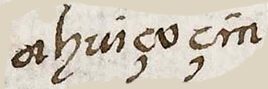
ahuiçoçin
Ahuitzotzin (Ahuitzotl)
Stephanie Wood
c. 1541, but by 1553 at the latest
Stephanie Wood
animals, animales, water, agua, nombres, tlahtoani, tlatoani, tecuhtli, tecutli, teuctli, fonetismo, men's names, nombres de hombres
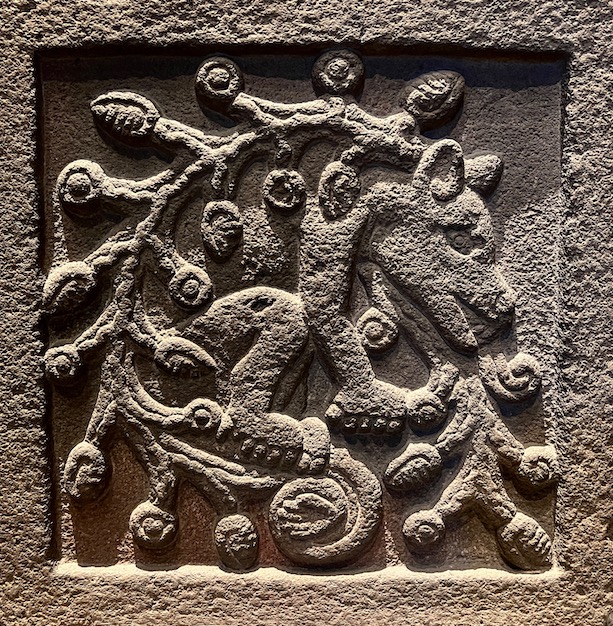
Ahuitzotl. The Lápida de Ahuitzotl, Museo Nacional de Antropología e Historia, Salón Mexica. Photograph by Robert Haskett, 14 February 2023. The stone is from the "Casa de Tepozteco," Tepoztlan, Morelos. A small hand appears at the bottom of the carving, nestled in the tip of the curling tail. This is an allusion to the animal's ability to reach up from under that water, grab someone, and pull that person down, resulting in a drowning. (SW)
a(tl), water, https://nahuatl.wired-humanities.org/content/atl
ahuitzo(tl), water dog, https://nahuatl.wired-humanities.org/content/ahuitzotl
huitz(tl), thorns, spines, https://nahuatl.wired-humanities.org/content/huitztli
-yo(tl), -yo(tl)-, having that characteristic or quality/inalienable possession, https://nahuatl.wired-humanities.org/content/yotl
-tzin (referential suffix), https://nahuatl.wired-humanities.org/content/tzin
"Revered Ahuitzotl" (Berdan and Anawalt, 1992, vol. 1, p. 233)
Animal del Agua (parecido al perro) (?)
Stephanie Wood
Codex Mendoza, folio 13 recto, https://digital.bodleian.ox.ac.uk/objects/2fea788e-2aa2-4f08-b6d9-648c00..., image 36 of 188.
Original manuscript is held by the Bodleian Libraries, University of Oxford, MS. Arch. Selden. A. 1; used here with the UK Creative Commons, “Attribution-NonCommercial-ShareAlike 3.0 License” (CC-BY-NC-SA 3.0)