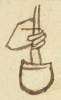
Aocnel (MH627v)
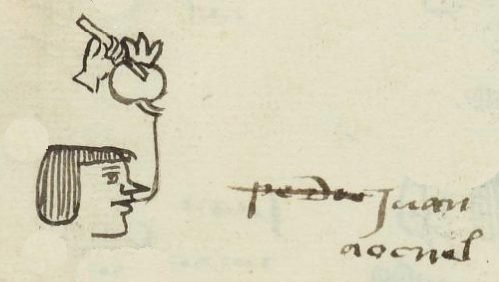
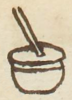
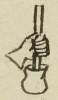
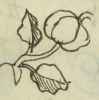
This black-line drawing of the compound glyph for the personal name Aocnel (perhaps "Good for Nothing," attested here as a man's name) shows what may be a squash or pumpkin (ayotl) with greenery (not colored here) on the top and perhaps a stem at the bottom. The ayotl serves as a near homophone for Aoc-. A hand to the left of the food item grasps a tool with which, perhaps, to stir and mix (-nenel) providing the phonetic syllable -nel- with which the name concludes.
Stephanie Wood
Aoc (an adverb) means no longer. Nel was originally short for nelli (an adjective), true, but James Lockhart explains that it became ubiquitous in particle combinations, losing the meaning of "true." See Lockhart's explanation in our Online Nahuatl Dictionary entry for canel.
Orozco y Berra suggests a translation of "bueno para nada," good for nothing. See our Dictionary entry.
Stephanie Wood
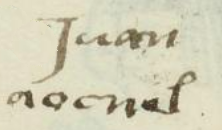
Juan
aocnel
Juan Aocnel
Stephanie Wood
1560
Jeff Haskett-Wood
medicinas, medicines, remedies, plantas, tubérculos, frutas, nombres de hombres, men’s names, fonetismo
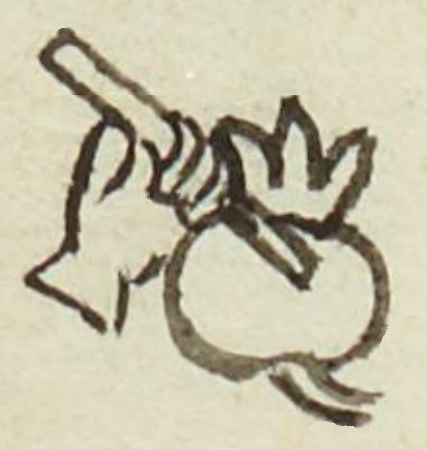
aoc, no longer, https://nahuatl.wired-humanities.org/content/aoc
nel(li), true, https://nahuatl.wired-humanities.org/content/nelli
aocnel, null, good for nothing, https://nahuatl.wired-humanities.org/content/aocnel
nenel-, mixed, https://nahuatl.wired-humanities.org/content/nenel
Bueno Para Nada
Stephanie Wood
Matrícula de Huexotzinco, folio 627v, World Digital Library, https://www.loc.gov/resource/gdcwdl.wdl_15282/?sp=337st=image.
This manuscript is hosted by the Library of Congress and the World Digital Library; used here with the Creative Commons, “Attribution-NonCommercial-ShareAlike 3.0 License” (CC-BY-NC-SAq 3.0).