Ayaquica (Verg39r)
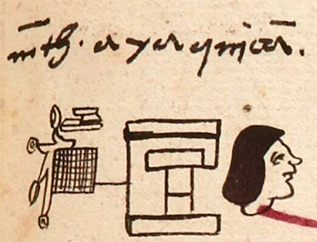
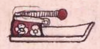
This compound Nahuatl hieroglyph is a black-line drawing of the personal name Ayaquica (or Ayac Ica, “With No One” or “Alone”). It is attested here as a man’s name. It sounds as though it could be a status, something like Single or Widower, but this man has a wife and a baby. The compound hieroglyph has three elements, starting with a flow of water (atl) on the left, with four short streams, alternating with shells and droplets or beads at the tips. The water provides the phonetic syllable A- at the beginning of the name. Next, to the right, is a mesh fabric (ayatl), which complements and continues the name through the first two phonetic syllables, Ayaq-. Above the fabric is a shoe (cactli), which provides the phonetic syllable -ca- that appears toward the end of the name.
Stephanie Wood
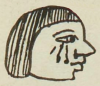
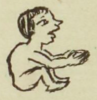
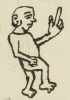
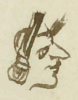
Ayaquica (or Ayac Ica) is a common name in this digital collection, appearing at least nine times in the Matrícula de Huexotzinco, and with this example, crossing regions. The iconography of these hieroglyphs includes three men with tears on their cheeks and four men who appear to be nude, which tends to be the case when someone is in a vulnerable situation. (Search the Cultural Content category “nudity” for other examples.) Something worth tracking is how one of the Ayaquica examples is an adult woman’s head, and yet this is the name for a man. One can also see other examples of this by searching the Cultural Content category, “Names (men’s but with female dimension).” A few examples of Ayaquica hieroglyphs appear below. None of them are fully phonetic like this one. This Tetzcocan manuscript has much more phoneticism than the Huexotzincan manuscript from 1560, which could be a regional and/or temporal difference.
This name--if deciphered correctly--is a complete sentence whereby the verb (to be) is implied, something very common in Nahuatl alphabetic and hieroglyphic writing. This sentence also includes a preposition (with, ica) and an indefinite pronoun (no one, ayac). Perhaps it is another way of referring to an orphan, a widow, or a widower.
A Google search of Ayaquica will bring up many names of people of Mexican heritage alive today. Some readers have suspected that this is a Quechua name from South America, and if it proves to be true, that will just be a coincidence, because it is definitely a Nahua name.
Stephanie Wood

mth. ayaquicā
Mateo Ayaquica
Stephanie Wood
1539
Jeff Haskett-Wood
solo, sola, solito, solita, viudo, viuda, soltero, soltera, nombres de hombres, men’s names, fonetismo

ayac, no one, https://nahuatl.wired-humanities.org/content/ayac
ica, with, https://nahuatl.wired-humanities.org/content/ica-0
aya(tl), a mesh fabric, https://nahuatl.wired-humanities.org/content/ayatl
cac(tli), a shoe, https://nahuatl.wired-humanities.org/content/cactli
Nadie Consigo, o Solo
Stephanie Wood
Available at Codex Vergara, folio 39r, https://gallica.bnf.fr/ark:/12148/btv1b84528032/f85.item.zoom, accessed 1 March 2026. The Vergara is associated with Tepetlaoztoc, in the larger region of Tetzcoco, c. 1539–1543. “Source gallica.bnf.fr / BnF.” We would also appreciate a citation to the Visual Lexicon of Aztec Hieroglyphs, https://aztecglyphs.wired-humanities.org/.
Image Rights: The non-commercial reuse of images from the Bibliothèque nationale de France is free as long as the user is in compliance with the legislation in force and provides the citation: “Source gallica.bnf.fr / Bibliothèque nationale de France” or “Source gallica.bnf.fr / BnF.” We would also appreciate a citation to the Visual Lexicon of Aztec Hieroglyphs, https://aztecglyphs.wired-humanities.org/