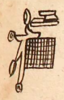
cactli (TK222v)
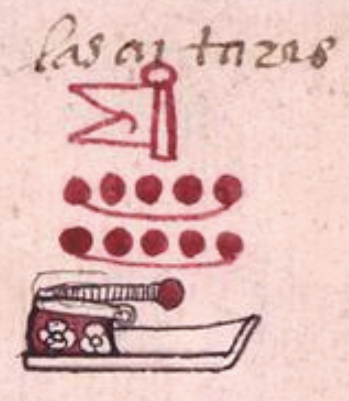
This painted simplex Nahuatl hieroglyph represents a sandal (cactli), although we are surmising this because there is no Nahuatl-language gloss. Instead, the Spanish gloss refers to the “simple sandal” (cutara), which implies the cactli, and it looks like one. The sole is flat and rectangular. The part around the heel is red with white flowers, possibly in a quincunx shape, although one seems only to have three petals. Both visible flowers have a small round center. The strap that goes around the ankle has hatch marks and a red round ball at the end. As the contextualizing image shows, this was a tribute item of which 200 pair had to be presented to the local encomendero (a Spaniard holding a grant to collect tribute in kind and in labor from Tepetlaoztoc). The notation for 200 shows one tecpantli flag and two groups of five ones, with lines connecting them. This is a multiplication equation.
Stephanie Wood
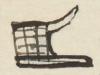
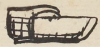
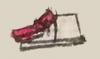
The term cactli was Hispanized as cacle, still used in contemporary Mexico. A few cactli appear below; note, too, that this sandal was sometimes used as a phonetic syllable (e.g., Ayaquica).
Stephanie Wood
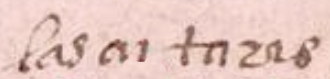
las cutaras
Stephanie Wood
c. 1556
Jeff Haskett-Wood
bandera, banderas, doscientos, cacles, flor, flores, quincunces, sandalia, sandalias
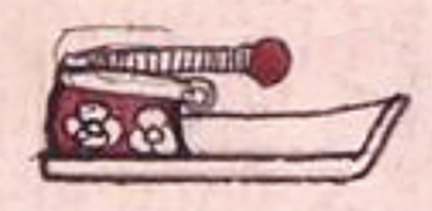
cac(tli), sandals or shoes, https://nahuatl.wired-humanities.org/content/cactli
el cacle, o la cutara
Stephanie Wood
The Codex Kingsborough, also known as the Códice de Tepetlaoztoc, and the Memorial de los indios de Tepetlaoztoc, is not on display. It was transferred from the British Library and is now held by the British Museum. It is shared on line at: https://www.britishmuseum.org/collection/object/E_Am2006-Drg-13964
©The Trustees of the British Museum. Shared under a Creative Commons Attribution-Non-Commercial-ShareAlike 4.0 International (CC BY-NC-SA 4.0) license. Please also cite the <em>Visual Lexicon of Aztec Hieroglyphsem>, ed. Stephanie Wood (Eugene, Ore.: Wired Humanities Projects, 2020-present) and this URL.