Cozcacuauh (Verg27r)
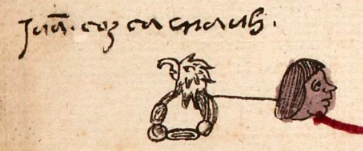
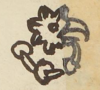
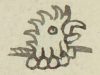
This compound Nahuatl hieroglyph is a black-line drawing of the personal name Cozcacuauh (“Vulture”), attested here as a man’s name. It has two elements. First is the necklace (cozcatl), which is not meant literally, but is a phonetic indicator that the name begins with Cozca-. The second element is the head of an eagle (cuauhtli), shown in profile, facing left. Combined, these elements create the term for vulture, cozcacuauhtli. So the spelling is phonetic.
Stephanie Wood
It is probably the case that the people who originally named the vulture thought that it had interesting feathers at its neck line, perhaps reminiscent of a necklace, and setting it off from the eagle. This vulture is a day name in the 260-day religious divinatory calendar. As is the case here, other examples of the name Cozcacuauh often lack the companion number (1 through 13) from the calendar. Whether this omission may have been an effort to disguise that these were calendrical names (in the face of disapproving colonial clergy). If this manuscript is as early as many believe, it would probably not be likely that this was a case of forgetting the iconography. Other Cozcacuauh compounds without their companion numbers appear on folios 29 recto and 31 verso. Serious events in Tetzcoco in 1539 may have made Nahua tlacuilos more cautious when writing and painting about aspects of their faith. See Patricia Lopes Don for information about the Inquisition case against don Carlos Ometochtli, a Chichimecatecuhtli (or Chichimecateuctli) executed in late 1539, in Bonfires of Culture, 2010. Bradley Benton (The Lords of Tetzcoco, 2017, 46) also writes that the case “demonstrates that blatant disregard for Christianity had serious consequences.”
Stephanie Wood

juā. cozcacuauh.
Juan Cozcacuauh
Stephanie Wood
1539
Jeff Haskett-Wood
buitres, buitres reyes, pájaro, pájaros, collar, collares, cuentas, joyas, fonetismo, nombres de hombres, men’s names

cozcacuauh(tli), a vulture, https://nahuatl.wired-humanities.org/content/cozcacuauhtli
Buitre
Stephanie Wood
Available at Codex Vergara, folio 27r, https://gallica.bnf.fr/ark:/12148/btv1b84528032/f61.item.zoom, accessed 22 February 2026. The Vergara is associated with Tepetlaoztoc, in the larger region of Tetzcoco, c. 1539–1543.
“Source gallica.bnf.fr / BnF.” We would also appreciate a citation to the Visual Lexicon of Aztec Hieroglyphs, https://aztecglyphs.wired-humanities.org/.
Image Rights: The non-commercial reuse of images from the Bibliothèque nationale de France is free as long as the user is in compliance with the legislation in force and provides the citation: “Source gallica.bnf.fr / Bibliothèque nationale de France” or “Source gallica.bnf.fr / BnF.” We would also appreciate a citation to the Visual Lexicon of Aztec Hieroglyphs, https://aztecglyphs.wired-humanities.org/