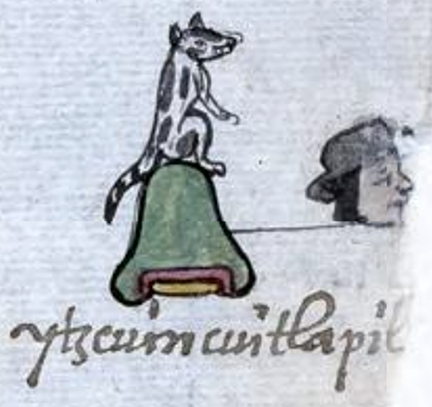
Itzcuincuitlapilco (Osu36r)
This painted compound Nahuatl hieroglyph represents the place name Itzcuincuitlapilco (perhaps "At the Dog Tail"). The focus of this glyph is a dog (itzcuintli) that is white with black patches. It is sitting upright on its haunches, in profile, facing the viewer's right, on the top of a hill or mountain (tepetl). The mountain may be a generic visual locative, or it might suggest that this place is an altepetl (in that it also gives attention to the opening at its base where natural spring water could emerge from between the red and yellow horizontal stripes). The dog's long tail (cuitlapilli) is hanging down the mountain slope. Some protruding teeth may be visible on the dog. Its visible front paw hangs in the air in front of the animal.
Stephanie Wood
The other example of a glyph for Itzcuincuitlapilco in this collection gives more emphasis to the dog's bottom and tail (cuitlapilli) and has the dog in a position where it might be about to make a bowel deposit (cuitlatl). Cuitlatl is at the root of the word for tail (the location for the emergence of the excrement).
Stephanie Wood
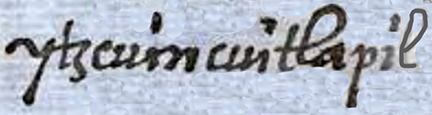
ytzcuincuitlapil[..]
Itzcuincuitlapil[co]
Stephanie Wood
1551–1565
Jeff Haskett-Wood
perro, perros, cola, colas, excremento, pelaje, manchas negras, cerro, cerros, montaña, montañas, nombres de lugares, place names, topónimo, topónimos
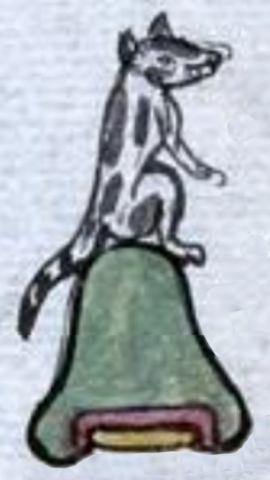
itzcuin(tli), dog, https://nahuatl.wired-humanities.org/content/itzcuintli
cuitla(tl), excrement, https://nahuatl.wired-humanities.org/content/cuitlatl
cuitlapil(li), tail, https://nahuatl.wired-humanities.org/content/cuitlapilli
posiblemente, "En la Cola del Perro"
Stephanie Wood
Library of Congress Online Catalog and the World Digital Library, Osuna Codex, or Painting of the Governor, Mayors, and Rulers of Mexico, https://www.loc.gov/resource/gdcwdl.wdl_07324/. The original is located in the Biblioteca Nacional de España.
"The Library of Congress is unaware of any copyright or other restrictions in the World Digital Library Collection. Absent any such restrictions, these materials are free to use and reuse." But please cite the Biblioteca Nacional de España and this Visual Lexicon of Aztec Hieroglyphs if you use any of these images here or refer to the content on this page, providing the URL