Macuil (MH667r)
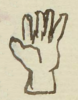
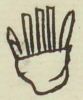
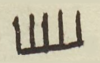
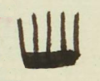
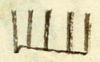
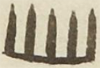
This black-line drawing of the compound glyph plus notation for the personal name Macuil (“Five”) is attested here as a man’s name. The glyph shows a hand (maitl) and a hand-held device (ma-), like a stick, on the top of which are five black lines spread out like fingers. This notation for the number five is attached to the top of the stick where it bends and turns to the viewer’s left.
Stephanie Wood
The result is a compound glyph, logographic and phonographic, because some of the parts contribute to the Ma- start to the name, and the notation adds the number five(macuilli). Most likely, this name was originally a calendrical name, and there was a day name from the 260-day religious divinatory calendar (tonalpohualli) that once accompanied the number. Whether this evolution in naming practices suggests a gradual forgetting of the divinatory calendar naming practice, some self-censoring as ecclesiastical influence grew, or a response to the pressure exerted by the clergy, who were actively pressing for change, are processes that require further investigation.
Another option is that the name Macuil had a meaning associated with lasciviousness. There were five divine forces called Ahuiteteo ("Cheerful Deities") known for "voluptuousness and lust," and each one of the five had a calendrical name that started with the number five (macuilli), a "symbol of excesses" (according to signage at the Templo Mayor), perhaps sexual excesses.This is one of the most popular number names in this entire collection, and it lives on in the present. See some additional examples below.
Stephanie Wood
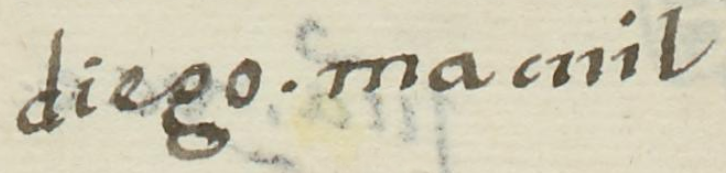
1560
Jeff Haskett-Wood
macuilli, five, cinco, mano, nombres de hombres
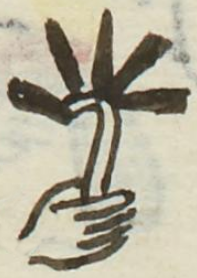
ma(itl), hand, https://nahuatl.wired-humanities.org/content/maitl
macuil(li), five, https://nahuatl.wired-humanities.org/content/macuilli
Cinco
Stephanie Wood
Matrícula de Huexotzinco, folio 667r, World Digital Library, https://www.loc.gov/resource/gdcwdl.wdl_15282/?sp=414&st=image.
This manuscript is hosted by the Library of Congress and the World Digital Library; used here with the Creative Commons, “Attribution-NonCommercial-ShareAlike 3.0 License” (CC-BY-NC-SAq 3.0).