Mapachtepec (Mdz13v)
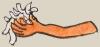
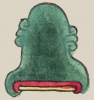
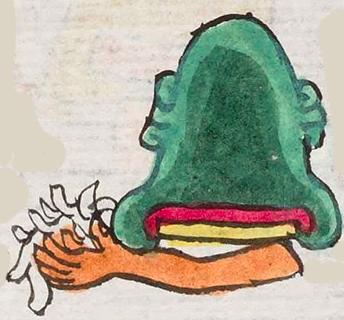
This compound glyph features a standard hill or mountain (tepetl), painted in two tones of green and with a yellow and a red horizontal stripe at the bottom. Below the mountain is an arm and hand (maitl), reaching to the viewer's left. The (left) hand holds a substance called pachtli, which looks like hay, although it has other definitions, too (mistletoe, chaff, or refuse of plants). The locative suffix (-c) (as given in the gloss) is not shown visually, but it combines with -tepe- to form -tepec, a visual locative suffix meaning "on the hill" or "on the mountain." The resulting translation may be, "On the Hill for Getting Hay."
Stephanie Wood
Este glifo compuesto nos muestra una colina o montaña (tepetl) con la forma clásica náhuatl, pintada con dos tonos de verde y con dos franjas horizontales (una roja y otra amarilla) en la parte inferior. Debajo de la montaña se aprecia un brazo con su mano (maitl) que se extiende hacia la izquierda del espectador. La mano sostiene algo llamado pachtli que tiene la apariencia de heno o paja, aunque cuenta con otras definiciones (muérdago, cascarilla o restos de plantas). El sufijo locativo (-c) que aparece en la glosa no se muestra de forma visual, pero se combina con -tepe- para formar -tepec, un sufijo locativo visual que significa “en la colina” o “en la montaña”. La traducción sería entonces “En la colina donde se obtiene la paja”.
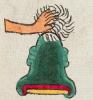
Perhaps this hand has taken (involving the verb ma, "to take"] the chaff (pachtli), or in fact has stolen it, given that mapachin means thief (and, by extension, raccoon, given their nocturnal activities). The placement of the grabbing hand is on top of the mountain in the other rendition of Mapachtepec included in this collection and taken from the Codex Mendoza (see below, right). The locative suffix (-c) is not shown visually in either example, but -tepec is a locative of its own. The reading of this glyph is supported by some phonetic redundancy or phonetic clues to help the reader arrive at the proper meaning. Still, the final reading is ambiguous. Does it refer to a place known for raccoons? (Why wouldn't the artist have drawn this animal?) Or does it refer to a place where people can get hay? Karttunen even adds "moss" and "plant refuse" as possibilities for "pach."
Stephanie Wood
Quizá la mano ha tomado (con el verbo ma, tomar) la paja (pachtli) o se la ha robado, dado que mapachin significa ladrón (y por extensión mapache, dadas las actividades nocturnas del animal). En el otro ejemplo de Mapachtepec de nuestra colección proveniente del Códice Mendocino (véase más abajo a la derecha), la mano aferrante aparece encima de la montaña. El sufijo locativo (-c) no se muestra de manera visual en ninguno de estos ejemplos, pero -tepec es ya un locativo. La interpretación de este glifo puede basarse en la redundancia fonética o en pistas igualmente fonéticas que le permitirán al lector deducir el significado correcto; pero aun así la interpretación final es ambigua: ¿se refiere a un lugar conocido por su abundancia de mapaches? Si es así, ¿por qué el tlacuilo no plasmó al animal? ¿O se refiere a un lugar en donde se puede conseguir heno o paja? Karttunen incluso añade “musgo” o “desechos de plantas” como posibles significados de “pach”.
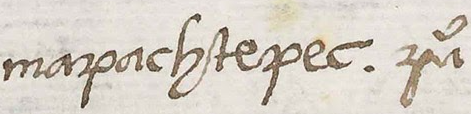
mapachtepec. puo
Mapachtepec, pueblo
Stephanie Wood
c. 1541, or by 1553 at the latest
Stephanie Wood
The hand and its contents are counted here as separate elements, even though there is overlap.
stealing, thief, thieves, thievery, raccoons, hands, arms, mountains, hills, ladrón, ladrones, robar, mapaches, manos, brazos, montañas, cerros, nombres de lugares
mai(tl), hand, https://nahuatl.wired-humanities.org/content/maitl
ma(tl), hand/arm, measurement, https://nahuatl.wired-humanities.org/content/matl
ma, take, hunt, capture, https://nahuatl.wired-humanities.org/content/ma
mapach(in), thief or raccoon, https://nahuatl.wired-humanities.org/content/mapachin
pach(tli), mistletoe, hay, chaff or refuse of plants, https://nahuatl.wired-humanities.org/content/pachtli
tepe(tl), hill or mountain, https://nahuatl.wired-humanities.org/content/tepetl
-tepec, on the hill or mountain, https://nahuatl.wired-humanities.org/content/tepec
"On the Hill of the Raccoon" (Berdan and Anawalt, 1992, vol. 1, p. 191)
Codex Mendoza, folio 13 verso, https://digital.bodleian.ox.ac.uk/objects/2fea788e-2aa2-4f08-b6d9-648c00..., image 37 of 188.
The Bodleian Libraries, University of Oxford, hold the original manuscript, the MS. Arch. Selden. A. 1. This image is published here under the UK Creative Commons, “Attribution-NonCommercial-ShareAlike 3.0 License” (CC-BY-NC-SA 3.0).