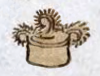
Maxtlazaca (Verg39v)
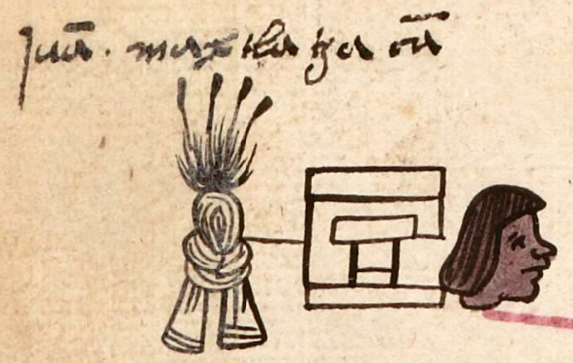
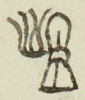
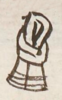
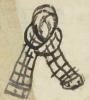
This compound Nahuatl hieroglyph is a black-line drawing of the personal name Maxtlazaca (“Loincloth of Grass”), attested here as a man’s name. The glyph elements include a frontal view of a loincloth (maxtlatl) that is tied and includes lines that give it a three-dimensionality. Above the garment is a clump of grass (zacatl) with four sprigs with what appear to be black blossoms. The compound is fully logographic.
Stephanie Wood
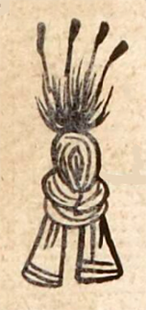
Another Maxtlazaca in this collection comes from the Matrícula de Huexotzinco (below), which attests that this is a name that transcends regions. The simpler name, Maxtla, is somewhat more common, being the name of a fifteenth-century Tepanec ruler (tlatoani or tlahtoani) of Azcapotzalco, and he was the son of the famous Tezozomoc, so this was a name that was passed down through many generations and probably given to Nahuas with various ethnic associations.
Stephanie Wood
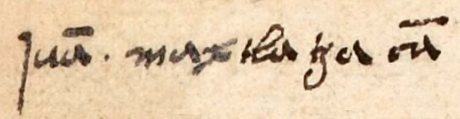
juā. maxtlatzacā
Juan Maxtlazaca
Stephanie Wood
1539
Jeff Haskett-Wood
grass, hay, paja, textiles, loincloths, nombres de hombres, men’s names
maztla(tl), a loincloth, https://nahuatl.wired-humanities.org/content/maxtlatl
zaca(tl), grasses, https://nahuatl.wired-humanities.org/content/zacatl
Taparrabo de Hierbas
Stephanie Wood
Available at Codex Vergara, folio 39v, https://gallica.bnf.fr/ark:/12148/btv1b84528032/f86.item.zoom, accessed 10 March 2026. The Vergara is associated with Tepetlaoztoc, in the larger region of Tetzcoco, c. 1539–1543. “Source gallica.bnf.fr / BnF.” We would also appreciate a citation to the Visual Lexicon of Aztec Hieroglyphs, https://aztecglyphs.wired-humanities.org/.
Image Rights: The non-commercial reuse of images from the Bibliothèque nationale de France is free as long as the user is in compliance with the legislation in force and provides the citation: “Source gallica.bnf.fr / Bibliothèque nationale de France” or “Source gallica.bnf.fr / BnF.” We would also appreciate a citation to the Visual Lexicon of Aztec Hieroglyphs, https://aztecglyphs.wired-humanities.org/