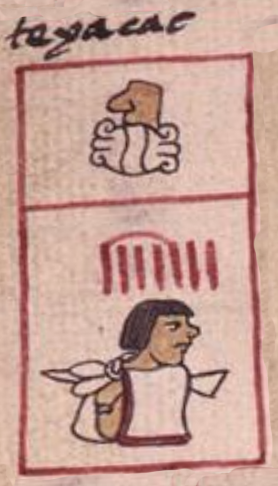
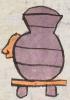
Teyacac (TK208v)
This painted compound Nahuatl hieroglyph represents the place name Teyacac (“Stone Point”). It has two elements, and it is read upward. At the bottom is a horizontal stone (tetl) with its classic curling ends and wavy double line that is vertical across the middle. Above the stone is a human nose (yacatl), painted a terracotta color. It is shown in profile facing toward the viewer’s left. The locative suffix (-c) is not included visually.
Stephanie Wood
The nose (yacatl) is almost a disyllabogram for -yaca-, but yacatl does not solely mean nose. It can also mean “point” and someone or something “in the lead.” See, for example, the glyph below for Tlayacac.
Side Note: The folio numbers are not always clear in the copy published online by the British Museum. Marc Thouvenot gives this page the number K06_B in his TLACHIA digital collection, https://tlachia.iib.unam.mx/tepetlaoztoc/K06_B.
Stephanie Wood
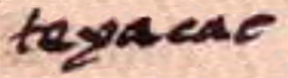
teyacac
Teyacac
Stephanie Wood
c. 1556
Jeff Haskett-Wood
puntas, picos, piedras, nombres de lugares, topónimo, topónimos
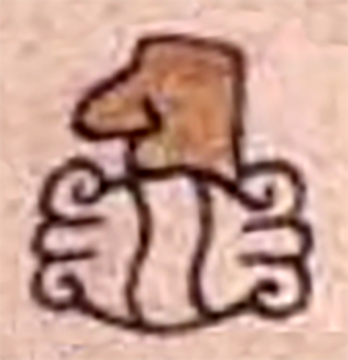
te(tl), stone, https://nahuatl.wired-humanities.org/content/tetl
yaca(tl), nose, point, lead, https://nahuatl.wired-humanities.org/content/yacatl
Punta de Piedra
Stephanie Wood
The Codex Kingsborough, also known as the Códice de Tepetlaoztoc, and the Memorial de los indios de Tepetlaoztoc, is not on display. It was transferred from the British Library and is now held by the British Museum. It is shared on line at: https://www.britishmuseum.org/collection/object/E_Am2006-Drg-13964
©The Trustees of the British Museum. Shared under a Creative Commons Attribution-Non-Commercial-ShareAlike 4.0 International (CC BY-NC-SA 4.0) license. Please also cite the <em>Visual Lexicon of Aztec Hieroglyphsem>, ed. Stephanie Wood (Eugene, Ore.: Wired Humanities Projects, 2020-present) and this URL.