tlatoani (Osu34r)
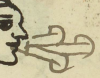
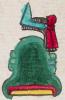
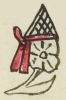
This painted compound Nahuatl hieroglyph is not glossed, but the elements clearly relate to the title tlatoani (or tlahtoani, with the glottal stop). The elements include what is known as the xiuhhuitzolli, a type of crown that ties at the back of a man’s head and has a clear association with a lord, a man with a very high social status. Near this crown are two volutes or speech scrolls that refer to the authority a ruler has to speak (tlatoa). This is both phonetic and semantic. A ruler is one who speaks (tlatoani). The crown is turquoise blue (fitting for the xiuh- start to the term for the headgear). It has a black line along the top edge, and the tie is red with gold at the lower tips. The speech scrolls are red nearest to what would be the location of the mouth and white at the ends that curl under. Red and white are revered colors; they also appear on flint knives, for example.
Stephanie Wood
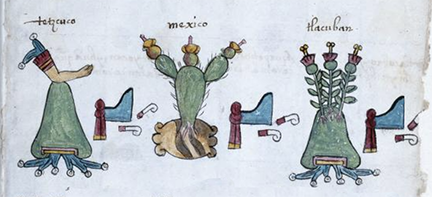
Speech scrolls are well attested to stand for tlatoa in a range of hieroglyphs (some appear below). The same can be said for the xiuhhuitzolli representing a lord (tecuhtli or teuctli). In the contextualizing image, place glyphs for the three cities at the center of the Aztec Triple Alliance, and each one appears with this sign for a high ruler, which is fitting. Mexico Tenochtitlan is at the very center of this trio.
Stephanie Wood
1551–1565
Jeff Haskett-Wood
señor, señores, gobernantes, gobernante, atado, voluta, volutas

tlatoani, ruler, one who speaks, https://nahuatl.wired-humanities.org/content/tlatoani
el gobernante
Stephanie Wood
Library of Congress Online Catalog and the World Digital Library, Osuna Codex, or Painting of the Governor, Mayors, and Rulers of Mexico, https://www.loc.gov/resource/gdcwdl.wdl_07324/. The original is located in the Biblioteca Nacional de España.
"The Library of Congress is unaware of any copyright or other restrictions in the World Digital Library Collection. Absent any such restrictions, these materials are free to use and reuse." But please cite the Biblioteca Nacional de España and this Visual Lexicon of Aztec Hieroglyphs if you use any of these images here or refer to the content on this page, providing the URL.