Xiquipilco (TR37v)
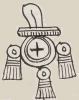
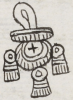
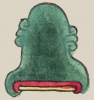
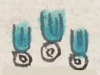
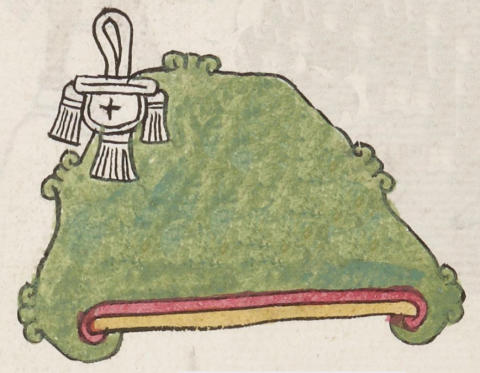
This compound Nahuatl hieroglyph stands for the place name Xiquipilco (which refers to the place where people made the special bags called xiquipilli). The compound shows a frontal view of a green, bell-shaped mountain or hill (tepetl), which plays a semantic role in saying this is a place (in lieu of showing the -co locative visually). The mountain has five rocky tetl) outcroppings, one at the top and two on the slopes. In words where the tepetl is not silent, the tetl serves as a phonetic indicator for the start of tepetl. At the base of the hill are the usual horizontal stripes in red and yellow, the site from which a natural spring might emerge. See the article about red and yellow "interiors" on the left for more about this phenomenon. On the top and somewhat to the left of the hill or mountain is a looping-handled bag with a horizontal fringe below the loop and three tassels, one on each side and one at the bottom of the bag. The front of the bag has a cross (+) in the middle of a white area.
Stephanie Wood
The sack was a traditional bag that held either cacao beans or incense, apparently in quantities of 8,000 pieces, given that the bag ended up representing the number eight thousand more generally. It is unclear here what material (cotton?) went into the bag's construction. The cross probably does not represent Christian influence in the design of this important bag, as this shape of cross existed in Nahua culture prior to contact, as did the x-shape cross. The cross may be an indication of preciosity, as it also appears on the hieroglyph for gold.
Stephanie Wood

xiquipilco
Xiquipilco
Stephanie Wood
1578
Jeff Haskett-Wood
hills, mountains, cerros, montañas, bags, sacos, bolsas, xiquipiles, nombres de lugares
xiquipil(li), a special sack or bag for cacao beans or incense, https://nahuatl.wired-humanities.org/content/xiquipilli
-co, locative suffix, https://nahuatl.wired-humanities.org/content/co
la bolsa [de 8,000], el xiquipile
Stephanie Wood
The Codex Telleriano-Remensis is hosted on line by the Bibliothèque nationale de France.
https://gallica.bnf.fr/ark:/12148/btv1b8458267s/f100.item. We have taken this detail shot from folio 37 verso.
This manuscript is not copyright protected, but please cite Gallica, the digital library of the Bibliothèque nationale de France or cite this Visual Lexicon of Aztec Hieroglyphs, ed. Stephanie Wood (Eugene, Ore.: Wired Humanities Projects, 2020–present) and the URL for each particular record.