Yaoitzcuin (MH644r)
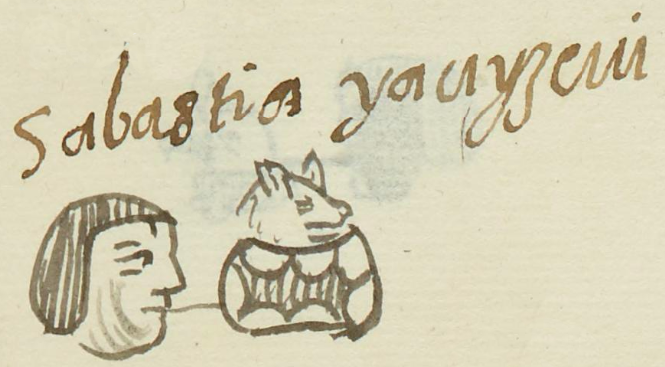
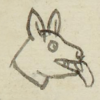
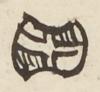
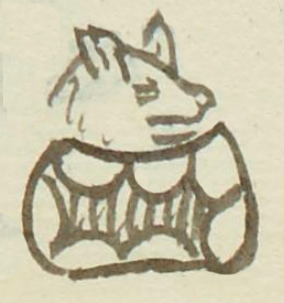
This black-line drawing of the compound Nahuatl hieroglyph for the personal name Yaoitzcuin (perhaps "Combative Dog," attested here as a man's name) shows the head of a dog (itzcuintli) in profile, looking toward the viewer's right. Its eye and mouth are open. Below the dog's head is a turtle (ayotl) shell that resembles a war shield (usually chimalli, but in this context referring to yaotl, which can be translated as enemy or combatant). Ayotl is a near homonym for yaotl, so it serves here as a phonetic indicator.
Stephanie Wood
Este dibujo de trazos negros del jeroglífico compuesto náhuatl para el nombre propio Yaoitzcuin (quizá “Perro Combativo”) se registra aquí como el nombre de un hombre y nos muestra la cabeza de un can (itzcuintli) de perfil que mira hacia la derecha del espectador. Debajo del animal aparece un caparazón de tortuga (ayotl) que se parece a un escudo de guerra, el cual en general se denominaba chimalli, pero que en el presente contexto se refiere a yaotl, un término que puede traducirse como “enemigo o “combatiente”. Ayotl es un homónimo casi perfecto de yaotl, por lo cual funge como un indicador fonético.
The increasing replacement of war shields with turtle shells deserves research. It could be a voluntary disguise or an externally-imposed suppression of the more threatening glyph name. It could also represent a gradual loss of memory for how the hieroglyph was drawn originally.
The tonalpohualli, being used for "prognostication and divination, had no parallel and contravened Christian dogma so its use was disavowed and prohibited." [See Rubén G. Mendoza, Ritual Human Sacrifice in Mesoamerica (2024), 439.] Nevertheless, calendrics were an important part of Nahuas' religious views of the cosmos, and this practice survived a long time under colonialism, even if in modified form.
Stephanie Wood
Deberíamos investigar más a fondo el creciente remplazo de los glifos de escudos de guerra por los de caparazones de tortuga: podría tratarse de un ocultamiento intencional o de la supresión impuesta de un glifo de nombre propio amenazador, pero también podría representar una pérdida gradual del conocimiento de cómo se dibujaba el jeroglífico en sus orígenes.
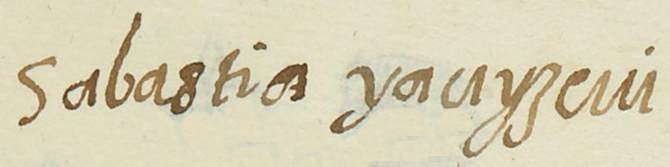
sabastia yauyzcui
Sebastián Yaoitzcuin
Stephanie Wood
1560
Jeff Haskett-Wood
shields, rodelas, escudos, perros, combatientes, nombres de hombres, men's names, fonetismo
yao(tl), combatant, https://nahuatl.wired-humanities.org/content/yaotl
ayo(tl), turtle, https://nahuatl.wired-humanities.org/content/ayotl
itzcuin(tli), dog, https://nahuatl.wired-humanities.org/content/itzcuintli
Guerra-Perro
Stephanie Wood
Matrícula de Huexotzinco, folio 644r, World Digital Library, https://www.loc.gov/resource/gdcwdl.wdl_15282/?sp=370&st=image
This manuscript is hosted by the Library of Congress and the World Digital Library; used here with the Creative Commons, “Attribution-NonCommercial-ShareAlike 3.0 License” (CC-BY-NC-SAq 3.0).