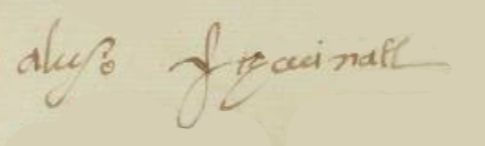
Itzcuinatl (MH815v)
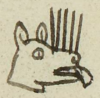
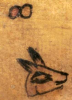
This black-line drawing of the compound glyph for the personal name Itzcuinatl (literally, “Dog Water,”) is attested here as a man’s name. The glyph shows the head of a dog in profile, facing toward the viewer’s right. Below this head is a whirlpool of water, with a thick and a thin line of current.
Stephanie Wood
Este dibujo de trazos negros del glifo compuesto para el nombre propio Itzcuinatl (que significa de manera literal “Perro Agua”) se registra aquí como el nombre de un hombre y nos muestra la cabeza de un can de perfil que mira hacia la derecha del espectador. Debajo del animal se aprecia un remolino de agua con una línea gruesa y otra fina que indican corrientes.
Both itzcuintli and atl were day signs of the tonalpohualli, the religious 260-day divinatory calendar, which was a source of many Nahua names. Usually, however, calendrical names were one day name, plus a number from 1 to 13.
Stephanie Wood
Itzcuintli y atl eran signos de días en el tonalpohualli, el calendario religioso-adivinatorio de 260 días, del cual se tomaban muchos nombres nahuas; sin embargo, lo normal era que los nombres calendáricos consistiesen en el nombre de un día más un número del uno al trece.
1560
Jeff Haskett-Wood
perros, agua, remolino, calendarios, nombres de días, nombres de hombres

itzcuin(tli), dog, https://nahuatl.wired-humanities.org/content/itzcuintli
a(tl), water, https://nahuatl.wired-humanities.org/content/atl
literalmente, Perro-Agua
Stephanie Wood
Matrícula de Huexotzinco, folio 815v, World Digital Library, https://www.loc.gov/resource/gdcwdl.wdl_15282/?sp=705&st=image.
This manuscript is hosted by the Library of Congress and the World Digital Library; used here with the Creative Commons, “Attribution-NonCommercial-ShareAlike 3.0 License” (CC-BY-NC-SAq 3.0).