Marina (LTlaxUT2a)
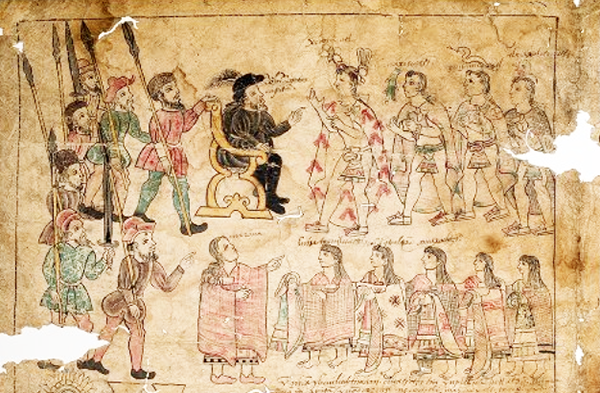
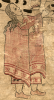
This iconographic example is included here for possible comparisons with Nahuatl hieroglyphs. It features Marina, the interpreter who worked alongside Cortés in the expedition across Mexico and through the struggle to seize and wield power in Tenochtitlan. This scene is from Tlaxcallan in 1519. She is interpreting the conversation between Cortés and Xicotencatl, who would become allies in the attacks on the Mexica. Marina was baptized with that name by the Spaniards, but the Nahuas, who had difficulty with the “r” in her name, which was not in their alphabet, called her Malintzin, adding the reverential suffix (-tzin). The name Malintzin would be difficult, in turn, for Spaniards to say, so they then Hispanized Malintzin, changing it to Malinche. Here she is wearing fine handwoven textiles: the blouse (huipilli) has a red mesh design with trim at the bottom and on her shoulders in red and white that features X-shapes with small arrows pointing toward the center of the X-shapes. A rectangle of fabric reinforces the V-neck. A skirt (cueitl) that is barely visible below the huipilli has both a large red and white design and a black and white horizontal check. Her shoes are red or pink. Her hair is wavy and long, falling over one shoulder and probably down her back.
Stephanie Wood
While the gloss with her name only says “Marina,” she would also be called doña Marina by many Spaniards, showing her more respect. Malintzin was also a name of respect. But, after Mexican independence from Spain, this woman became something of a scapegoat, blamed for helping the invaders succeed in conquering the Mexica, even though she had little say in the matter. So her name, Malinche, became one of derision, with lasting effect. She bore a child by Cortés, but again, that might not have been her choice. She was barely pubescent when she was taken along with a group of other Nahua women in the Gulf region and treated virtually as slaves. She rose in stature, however, when her knowledge of Mayan and Nahuatl made her indispensable as an interpreter. For further information on this topic, see: Frances Karttunen, “Rethinking Malinche,” in Indian Women of Early Mexico, eds. Susan Schroeder, Stephanie Wood, and Robert Haskett, 1997.
Stephanie Wood
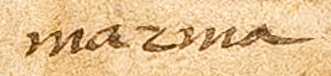
marina
Marina
Stephanie Wood
1540s
Jeff Haskett-Wood
intérprete, intérpretes, lenguaje, traducción, idiomas, lenguas, interpretación, nahuatlata, hablar, traducir, mujer, mujeres, náhuatl
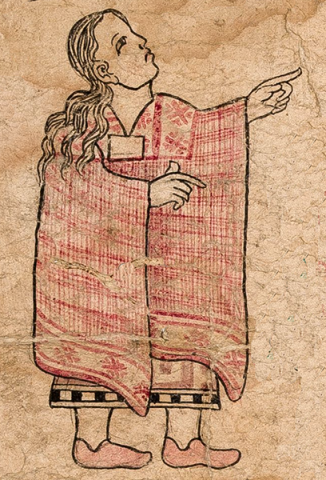
Marina, Nahua interpreter to Cortés, https://nahuatl.wired-humanities.org/content/marina
Marina
Stephanie Wood
Benson Latin American Collection, LLILAS Benson Latin American Studies and Collections, The University of Texas at Austin https://collections.lib.utexas.edu/catalog/utblac:3c754fd0-b27f-4af7-9cf...
The Benson Library has kindly provided the digital images and permission to put them into our Mapas Project in 2015. Use and reproduction from this project: https://creativecommons.org/publicdomain/mark/1.0/, but please also cite the Visual Lexicon of Aztec Hieroglyphs, ed. Stephanie Wood, (Eugene, Ore.: Wired Humanities Projects, ©2020-present). Version 1.0.