Tetzcoco (Osu34r)
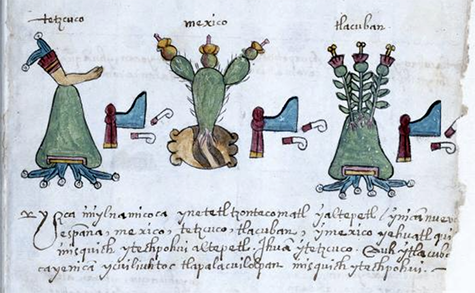
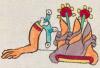
This painted compound Nahuatl hieroglyph represents the Acolhua region, and it is glossed for the city of Tetzcoco. The Codex Mendoza puts this glyph (as Acolhuacan, “Place of the Acolhua”) together with one for the city, which has small mountains (tetzcotl). This compound here has an arm that is severed at the shoulder (acolli), providing the phonetic disyllabogram, -acol-, for the start of the regional name. The upper part of the arm has multiple horizontal stripes in red, gold, and black. The top edge has short black lines running the other direction, seemingly indicating cuts. Water (atl) provides the complementary phonetic syllable -a- for the start of the place A-. The elbow is bent, and it is resting at the top of a green, bell-shaped mountain. This mountain has horizontal red and pink slits at its base, and water emerges from that site. The water consists of six short streams with lines of current and white water droplets or beads at the tips of the streams.
Stephanie Wood
The water that emerges from the arm and the mountain suggest and emergence from interiors, both bodily and earthly. See the essay on the left navigation bar about red and yellow as colors separating interiors from exteriors, both on humans and in the landscape. A mountain with the horizontal slits but no water emerging (the case with most mountains) does never the less imply the possibility of a natural spring, and atl plus tepetl are the roots of altepetl (a town or city-state). See below for other examples of water emerging from these slits.
Stephanie Wood
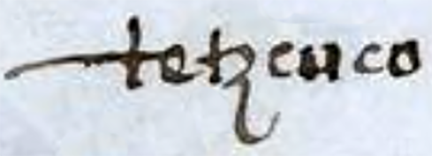
tetzcuco
Tetzcoco
Stephanie Wood
1551–1565
Jeff Haskett-Wood
acolhuas, hombro, hombros, agua, cerro, montaña, nombres de lugares, topónimo, topónimos

acol(li), shoulder, https://nahuatl.wired-humanities.org/content/acolli
a(tl), water, https://nahuatl.wired-humanities.org/content/atl
Lugar de los Acolhua
Stephanie Wood
Library of Congress Online Catalog and the World Digital Library, Osuna Codex, or Painting of the Governor, Mayors, and Rulers of Mexico, https://www.loc.gov/resource/gdcwdl.wdl_07324/. The original is located in the Biblioteca Nacional de España.
"The Library of Congress is unaware of any copyright or other restrictions in the World Digital Library Collection. Absent any such restrictions, these materials are free to use and reuse." But please cite the Biblioteca Nacional de España and this Visual Lexicon of Aztec Hieroglyphs if you use any of these images here or refer to the content on this page, providing the URL.