Tlacopan (Osu34v)
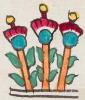
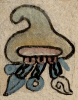
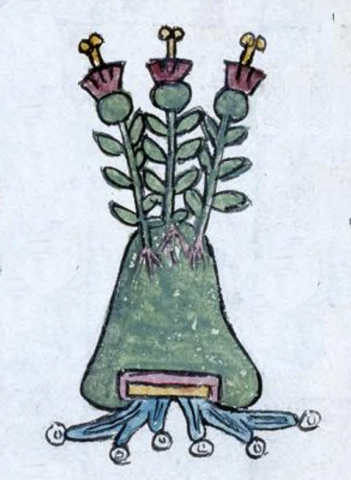
This painted compound Nahuatl hieroglyph represents the place name Tlacopan (perhaps “In the Osier Twigs,” Tacuba today). It shows a mountain or hill with three flowering osier twigs (tlacotl) growing out of the top. The plants’ roots are visible. Each tlacotl plant has many little leaves. Its flower has a base that is round and green, there are red petals above the base, and finally, the flower is topped with a pair of yellow anthers.The mountain is bell shaped. At its base are the very common horizontal red and yellow lines that suggest an opening to the interior (see the essay on the right-hand navigation bar about red and yellow). Sure enough this is where water springs forth from this mountain. It comes out in six little streams, each one with a line of current and a white droplet or bead at the tip.
Stephanie Wood
The water springing forth from the base of the mountain adds to the understanding of the diphrase atl tepetl, or altepetl, given that early settlements might have found a mountain location desirable for defense and a natural spring as essential for sustaining life. Two other examples (Ixicayan and Colhuacan), below, support this reading of the red and yellow horizontal opening at the base of the mountain as the site for the emergence of natural springs.
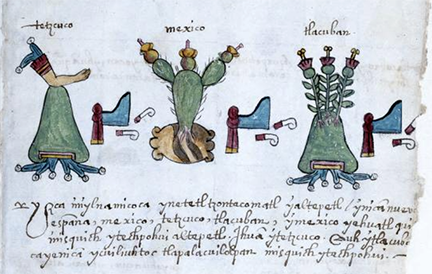
This place was originally on the western shore of Lake Tetzcoco and the ruling center of the Tepanecs. It was one of the three city-states that formed the Aztec Triple Alliance. The contextualizing image on this manuscript page highlights these three polities that formed the alliance. The other two are Tetzcoco and Mexico-Tenochtitlan. The Nahuatl text refers to these three altepetl as “in etetl tzontecomatl” (the three heads). Next to each place glyph is a xiuhhuitzolli or a copilli (like a crown that tied around the top of the head), a symbol for teuctli or tecuhtli, a lord or noble, or a reference to a tlatoani (tlahtoani with the glottal stop), ruler. Two red and white speech scrolls also appear next to each xiuhhuitzolli, which ensures the reading of tlatoani (the one who has the authority to speak).
Stephanie Wood
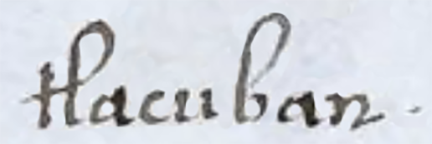
tlacuban
Tlacopan (Tacuba today)
Stephanie Wood
1551–1565
Jeff Haskett-Wood
flores, palos, mimbres, manantial natural, agua, nombre de lugar, topónimo, alianza triple, azteca, aztecas
tlaco(tl), osier twigs, https://nahuatl.wired-humanities.org/content/tlacotl
posiblemente, En los Ramas de Mimbre
Stephanie Wood
Library of Congress Online Catalog and the World Digital Library, Osuna Codex, or Painting of the Governor, Mayors, and Rulers of Mexico, https://www.loc.gov/resource/gdcwdl.wdl_07324/. The original is located in the Biblioteca Nacional de España.
"The Library of Congress is unaware of any copyright or other restrictions in the World Digital Library Collection. Absent any such restrictions, these materials are free to use and reuse." But please cite the Biblioteca Nacional de España and this Visual Lexicon of Aztec Hieroglyphs if you use any of these images here or refer to the content on this page, providing the URL.