Chiconquiyauhco (MH595v)
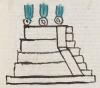
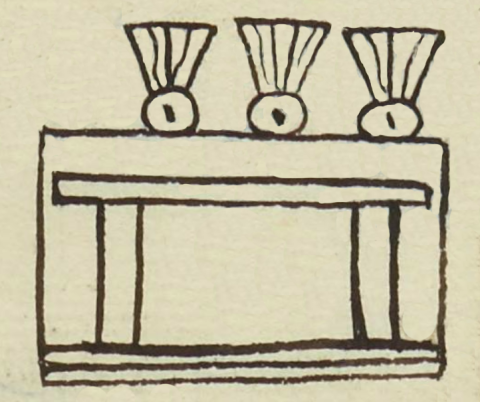
This black-line drawing of the compound glyph for the place name Chiconquiyauhco (“At 7-Rain,” which is calendar-based) shows a frontal view of a white building, and on the roof are three (not seven) rain glyphs. Rain is a day sign of the calendar; sometimes it is represented by the head of Tlaloc, the divine force of rain. But these glyphic elements here each have a triangular flow of water with a large droplet/bead at the bottom. The frontal view of the building helps the reader see that there is an entrance (quiyahuac), which serves as a phonetic reinforcement for the reading of rain (quiyahuitl).
Stephanie Wood
This place name involves a day sign that comes from the tonalpohualli, the 260-day divinatory calendar. Calendrics figure importantly in Nahuas' religious views of the cosmos. the dropping of any visual for the number seven (chicome) may seem surprising, but it is possible that this was a way to dodge the wrath of the colonial clergy, who were trying to discourage the use of the tonalpohualli. Serious events in 1539 may have made Nahua tlacuilos more cautious when writing and painting about aspects of their faith even twenth-one years later. See Patricia Lopes Don for information about the Inquisition case against don Carlos Ometochtli, a Chichimecatecuhtli (or Chichimecateuctli) executed in late 1539, in Bonfires of Culture, 2010. Bradley Benton (The Lords of Tetzcoco, 2017, 46) also writes that the case “demonstrates that blatant disregard for Christianity had serious consequences.” The tonalpohualli, being used for "prognostication and divination, had no parallel and contravened Christian dogma so its use was disavowed and prohibited." [See Rubén G. Mendoza, Ritual Human Sacrifice in Mesoamerica (2024), 439.] Nevertheless, calendrics were an important part of Nahuas' religious views of the cosmos, and this practice survived a long time under colonialism, even if in modified form.
As our Online Nahuatl Dictionary entry for quiyahuitl shows, there was a strong relationship between tears and raindrops. When children cried, people believed that to be a sign that it would rain. Rainfall had a strong association with the deity or priest called Tlaloc, who could bring on the rain and facilitate fertility in agriculture (Florentine Codex, Book 1). Tlaloc wore a necklace of green stones, which also symbolized water or precious raindrops.
For a visual of rain in the Florentine Codex, with its companion number "one" (another calendrical date), see this page in the Digital Florentine Codex, published by the Getty Research Institute.
Stephanie Wood
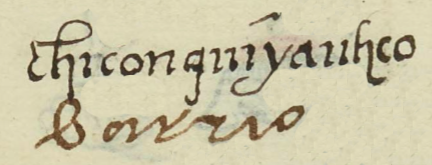
chiconquiyauhco
barrio
Chiconquiyauhco, barrio
1560
numbers, números, siete, tres, seven, three, rain, lluvia, storm, tormenta, casa, edificios, arquitectura, nombres de lugares, dates, fechas, signos de días, quiyahuac, entradas, afueras, fonetismo, place names, topónimos
chicome, seven, https://nahuatl.wired-humanities.org/content/chicome
quiyahuitl, rain or rainstorm, https://nahuatl.wired-humanities.org/content/quiyahuitl
quiyahuac, outside or entrance, https://nahuatl.wired-humanities.org/content/quiyahuac
-co (locative suffix), on or in, https://nahuatl.wired-humanities.org/content/co
En Siete-Lluvia, En 7-Lluvia
Matrícula de Huexotzinco, folio 595v, World Digital Library, https://www.loc.gov/resource/gdcwdl.wdl_15282/?sp=270&st=image.
This manuscript is hosted by the Library of Congress and the World Digital Library; used here with the Creative Commons, “Attribution-NonCommercial-ShareAlike 3.0 License” (CC-BY-NC-SAq 3.0).