ilpitoca (Osu12v)
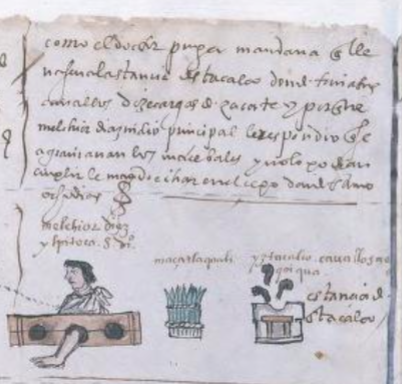
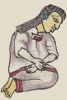
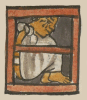
This iconographic example (practically a hieroglyph) comes from the Codex Osuna, folio 12 verso (or Image 27). It shows a man in a three-quarter view, facing toward the viewer’s left. One or two of his legs are protruding from a pair of wooden stocks (cepo, in the Spanish text). The stocks consist of two horizontal boards with three holes. Only one is being used in this case. In the Nahuatl gloss used here, the relevant verb is ilpitoca (to be tied or bound). Since the stocks have made him immobile, and he cannot extricate himself. This man, Melchor Diez, wears a white cotton cloak that is tied on his shoulder, suggesting he might not be a macehualli, but perhaps rather a pilli (a lesser noble).
Stephanie Wood
Este ejemplo iconográfico (que de hecho es casi un jeroglífico) proviene del reverso del folio 12 (o imagen 27) del Códice Osuna y nos muestra a un hombre de perfil de tres cuartos que mira hacia la izquierda del espectador. Una o sus dos piernas sobresalen de un par de cepos de madera (el texto en español utiliza el mismo término). El aparato consiste en dos planchas horizontales con tres agujeros, de los cuales solamente se utiliza uno en este ejemplo. En la glosa náhuatl del presente ejemplo, el verbo pertinente es ilpitoca (estar atado o amarrado), ya que el cepo ha inmovilizado al sujeto, un tal Melchior (Melchor) Diez, quien no puede escapar por sí mismo y viste una capa de algodón blanco atada por el hombro, lo cual nos sugiere que quizá no sea un macehualli, sino un pilli, un miembro de la baja nobleza.
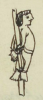
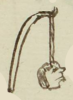
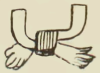
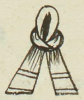
The loan from Spanish, cepo (stocks), did enter Nahuatl, as one can see in our Online Nahuatl Dictionary. Few are the hieroglyphs for forms of punishment, and some forms are Nahua. See below.
Stephanie Wood
La palabra cepo es un préstamo del español incorporado al náhuatl, como puede apreciarse en nuestro Online Nahuatl Dictionary. Contamos con pocos jeroglíficos que representen diferentes castigos y algunos de ellos son de origen nahua: véase más abajo.

ylpitoca.
ilpitoca
Stephanie Wood
1551–1565
Jeff Haskett-Wood
atar, atado, cepos, crimen, castigo, mal trato, españoles

ilpitoc, tied up or bound, https://nahuatl.wired-humanities.org/content/ilpitoc
cepo, stocks (a loan from Spanish), https://nahuatl.wired-humanities.org/content/cepo
atar
Stephanie Wood
Library of Congress Online Catalog and the World Digital Library, Osuna Codex, or Painting of the Governor, Mayors, and Rulers of Mexico (Pintura del Gobernador, Alcaldes y Regidores de México), https://www.loc.gov/resource/gdcwdl.wdl_07324/. The original is located in the Biblioteca Nacional de España.
"The Library of Congress is unaware of any copyright or other restrictions in the World Digital Library Collection. Absent any such restrictions, these materials are free to use and reuse." But please cite the Biblioteca Nacional de España and this Visual Lexicon of Aztec Hieroglyphs if you use any of these images here or refer to the content on this page, providing the URL.