Chipiltepec (TK207r)
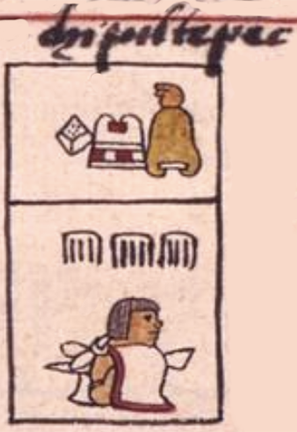
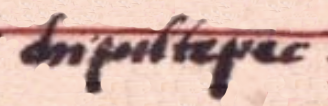
This painted compound Nahuatl hieroglyph represents the place name Chipiltepec (“Chipilin Hill” or “Chipilin Mountain”). Chipilín (accented in Spanish) is a green herb that is important in Mexican cuisine, often used for flavoring tamales. The compound glyph has four elements, and the reading order is from left to right. The first element is a sign for chiyantli, called chia in Spanish and English, which provides the phonetic syllable -chi-, the start to the place name. Next is a red and white handwoven blouse (huipilli), which supplies the phonetic syllable -pil-, the second syllable of the place name. Next is the set of terracotta-colored human lips (tentli), which sit atop the mountain or hill. Here, the lips contribute the phonetic syllable -te- for the start of the word tepetl (hill or mountain). And, finally, the fourth sign is the bell-shaped hill or mountain (tepetl) itself. It is painted brown but the horizontal bar near the bottom is left natural. The locative suffix (-c-) is not shown visually, although it is implied in the hill or mountain, given that it contributes to the sense of “place.”
Stephanie Wood
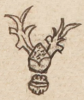
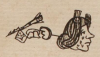
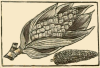
In a wider discussion of the use of chia as a phonetic syllable, Gordon Whittaker (2021, 133) has analyzed this compound hieroglyph as “chi-pil-te2-tepe.” One can see that the -te- syllable from tentli was not really necessary, but perhaps the tlacuilo wanted to ensure that the tepetl was read and not just left as a silent locative. The chia sign in manuscripts from this region is something like the centli or cintli of the central valley. Close comparisons may help the reader make the distinction. See the -chin- syllable from chiyantli in the glyph for Techin, the -cen- syllable from centli in Cen Icuic, and the -ci- syllable from cintli in Icnocihuatl. Further comparisons are warranted. Glyphs for centli and cintli from the central valley look much more like corn cobs.
Side Note: The folio numbers are not always clear in the copy published online by the British Museum. Marc Thouvenot gives this page the number K05_A in his TLACHIA digital collection, https://tlachia.iib.unam.mx/tepetlaoztoc/K05_A.
Stephanie Wood
chipiltepec
Chipiltepec
Stephanie Wood
c. 1556
Jeff Haskett-Wood
hierbas, comida, cerros, montañas, labios, cerro, cerros, montaña, montañas, nombres de lugares, topónimo, topónimos, fonetismo

chiyan(tli), chia, https://nahuatl.wired-humanities.org/content/chiyantli
huipil(li), handwoven blouse, https://nahuatl.wired-humanities.org/content/huipilli
ten(tli), lips, https://nahuatl.wired-humanities.org/content/tentli
tepe(tl), hill or mountain, https://nahuatl.wired-humanities.org/content/tepetl
Cerro Chipilín o Montaña Chipilín
Stephanie Wood
The Codex Kingsborough, also known as the Códice de Tepetlaoztoc, and the Memorial de los indios de Tepetlaoztoc, is not on display. It was transferred from the British Library and is now held by the British Museum. It is shared on line at: https://www.britishmuseum.org/collection/object/E_Am2006-Drg-13964
©The Trustees of the British Museum. Shared under a Creative Commons Attribution-Non-Commercial-ShareAlike 4.0 International (CC BY-NC-SA 4.0) license. Please also cite the <em>Visual Lexicon of Aztec Hieroglyphsem>, ed. Stephanie Wood (Eugene, Ore.: Wired Humanities Projects, 2020-present) and this URL.